Is cursing or swearing haram?
Question 1170
Question
Is it haram to curse or swear, including using bad words when angry, joking, or in pain?
Summary of answer
Cursing a person, wishing Allah's curse on them, and insulting or abusing people are haram, and habitual foul language is a fault the Prophet ﷺ never had. He said the believer is not a curser and that he himself was sent as a mercy and never as a curser. A word that slips out in pain or anger is met with repentance and mercy, and the Quran calls believers to say what is best (17:53).
Answer
الحمد لله Praise be to Allah.
People who ask whether cursing is haram usually mean one of two things. Some mean the curse proper (laʿn, لعن): wishing that Allah reject a person and put them far from His mercy. Others mean swearing in the everyday sense, the rude or obscene word (fuḥsh, فحش) that escapes in traffic, in a group chat, or when a hammer meets a thumb. The answer of the Quran and the Sunnah is clear and gentle. Cursing a person and insulting people are haram. Habitual foul language is a fault that a believer works to leave behind. A word that slips out in pain or anger is met with repentance and with Allah’s mercy.
What does the Quran say about cursing and bad language?
The Quran asks believers to choose the best of the words available to them:
وَقُل لِّعِبَادِي يَقُولُواْ ٱلَّتِي هِيَ أَحۡسَنُ
“Tell My servants to say what is best.”
The covenant Allah took from the Children of Israel included the command “Speak to people with goodness” (Quran 2:83). The Quran even forbids insulting the idols of others:
وَلَا تَسُبُّواْ ٱلَّذِينَ يَدۡعُونَ مِن دُونِ ٱللَّهِ فَيَسُبُّواْ ٱللَّهَ عَدۡوَۢا بِغَيۡرِ عِلۡمٖ
“Do not insult those they call upon besides Allah, or they will insult Allah in hostility, without knowledge.”
If believers may not insult a carved idol, they may not insult a human being made in the best of forms. One exception is given with care: “Allah does not love the public voicing of evil, except by one who has been wronged” (4:148). A person who has suffered injustice may name it openly in order to seek justice.
Is it haram to curse someone?
Calling down Allah’s curse on a person is among the sins of the tongue the Prophet ﷺ warned against most often. He said:
«لَيْسَ الْمُؤْمِنُ بِالطَّعَّانِ وَلاَ اللَّعَّانِ وَلاَ الْفَاحِشِ وَلاَ الْبَذِيءِ»
“The believer is no slanderer, no curser, no obscene or foul-mouthed person.”
Jamiʿ al-Tirmidhi 1977, graded sahih by al-Albani
When he was asked to curse the idolaters, he refused:
«إِنِّي لَمْ أُبْعَثْ لَعَّانًا وَإِنَّمَا بُعِثْتُ رَحْمَةً»
“I was not sent to curse. I was sent as a mercy.”
He said that cursing a believer is like killing him (Sahih al-Bukhari 6047), and that those given to cursing will be neither intercessors nor witnesses on the Day of Resurrection. Umm al-Dardāʾ reminded the caliph ʿAbd al-Malik ibn Marwān of this after hearing him curse a servant (Sahih Muslim 2598a).
The prohibition reaches animals and things as well. When a woman of the Anṣār cursed her restless camel, the Prophet ﷺ told the travelers to unload it and let it go (Sahih Muslim 2595a). Those who curse the times are reminded, in a hadith qudsī, that the night and the day are in Allah’s hand (Sahih Muslim 2246a).
Is swearing or using bad words haram?
The Prophet ﷺ was, in the words of ʿAbdullāh ibn ʿAmr, “neither obscene nor one who put on obscenity” (Sahih al-Bukhari 6029). When some men greeted him with a disguised wish for his death and Aisha (may Allah be pleased with her) answered them with curses, he told her: “Gently, Aisha. Hold to gentleness, and beware of harshness and foul words” (Sahih al-Bukhari 6030).
The scholars sorted bad language by what it does. An insult aimed at a person is haram, for “insulting a Muslim is wickedness” (Sahih al-Bukhari 48), and the same dignity belongs to every human being. Insulting someone’s mother or father is graver still: the Prophet ﷺ counted it among the major sins, because the other person will insult your parents in return (Sahih al-Bukhari 5973). Crude words used as filler, aimed at no one, are a blameworthy habit to outgrow. Imam al-Ghazali (d. 1111) gave a whole book of his Iḥyāʾ ʿUlūm al-Dīn to the faults of the tongue, obscenity and cursing among them.
What about words that slip out in pain or anger?
The sharia weighs intention. The Prophet ﷺ said that Allah pardons what passes through the minds of his community until they act on it or speak it (Sahih al-Bukhari 5269), and the Quran shows the same mercy to thoughtless words in oaths: Allah takes account of what the heart has earned (2:225). A word that escapes when you drop something on your foot carries little of the heart, and a sincere “astaghfirullāh” washes it away.
Anger is the usual doorway. When two men were trading insults before the Prophet ﷺ and one grew red in the face, he said that the man’s anger would leave him if he said “I seek refuge in Allah from Satan” (Sahih al-Bukhari 3282).
How can I stop cursing and swearing?
- Say good or stay silent. “Whoever believes in Allah and the Last Day, let him speak good or keep silent” (Sahih al-Bukhari 6018).
- Give your tongue a replacement. “Subḥān Allāh,” “bismillāh,” or “innā lillāh” fill the same moment and earn reward.
- Repair what you said. If you insulted someone, apologize. The neighboring faults of the tongue are discussed in Is lying haram? and What is backbiting?
- Watch your words online. A comment under a stranger’s post is still spoken to a human being of any faith (Can Muslims be friends with non-Muslims?).
- Be gentle at home. Kind words between parents and children keep the ties Allah commanded (Do I have to obey my parents?).
- Do not despair over old habits. Allah forgives the one who turns back to Him (Does Allah forgive all sins?).
A good word like a good tree
The Quran compares the good word to a tree:
أَلَمۡ تَرَ كَيۡفَ ضَرَبَ ٱللَّهُ مَثَلٗا كَلِمَةٗ طَيِّبَةٗ كَشَجَرَةٖ طَيِّبَةٍ أَصۡلُهَا ثَابِتٞ وَفَرۡعُهَا فِي ٱلسَّمَآءِ
“Do you not see how Allah sets forth a parable? A good word is like a good tree, its root firm and its branches in the sky.”
Every gentle word you choose in place of a harsh one plants something that keeps growing. May Allah sweeten our tongues, guard them from cursing, and make our speech a mercy to everyone who hears it.
And Allah knows best. والله أعلم
Frequently asked questions
Is it haram to swear in your head?
Thoughts that pass through the mind are pardoned. The Prophet ﷺ said that Allah overlooks what His servants say to themselves as long as they do not act on it or speak it (Sahih al-Bukhari 5269).
Is it haram to curse when you hurt yourself?
A word that escapes in sudden pain carries little intention, and Allah is gentle with it. Make it a habit to say something better in its place, such as 'innā lillāh' or 'bismillāh', and ask forgiveness when a bad word slips out.
Is it haram to curse Satan or oppressors?
The Quran itself speaks of Allah's curse on Satan and on the wrongdoers in general terms. Many scholars allowed cursing by such general descriptions and discouraged cursing a named living person, since the door of repentance is open to every human being.
Is it haram to swear in another language?
A word carries the meaning it has for the speaker and the listener. An insult in English, Arabic, or Urdu is the same insult, and a mild exclamation in any language takes the same lighter ruling.
Related questions
Sources
- Jamiʿ al-Tirmidhi 1977 (the believer is not a curser)
- Sahih Muslim 2597–2599 (on cursing)
- Sahih al-Bukhari 6029, 6030, 6047
- al-Ghazali, Iḥyāʾ ʿUlūm al-Dīn, Kitāb Āfāt al-Lisān (The Book of the Faults of the Tongue)
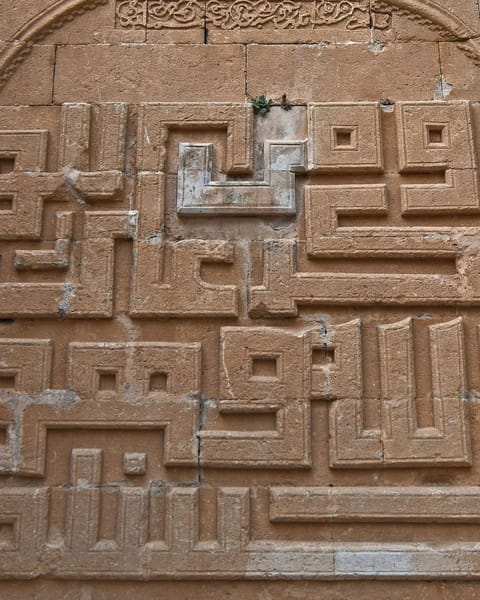
Image: Dosseman, Square Kufic carving at the Great Mosque of Mardin, 2025. CC BY-SA 4.0, via Wikimedia Commons.. Image credits
