Can Muslims be actors or act in movies?
Question 1168
Question
Is it permissible for a Muslim to become an actor or actress, to act in films, television, or theater, or to play characters whose beliefs differ from their own?
Summary of answer
Acting is halal. The Quran teaches through stories (12:3), the Prophet ﷺ listened to stories and enjoyed play, and Muslim societies have staged shadow plays, Shia passion plays, and a rich cinema from Cairo to Tehran. Acting deceives no one, since the audience knows the story is invented. The ruling on a particular role follows its content and the actor's intention, and Muslim actors choose roles that do not demean themselves or others.
Answer
الحمد لله Praise be to Allah.
Muslim actors work today in Hollywood and Bollywood, in the studios of Cairo, Istanbul, and Tehran, and on stages from London to Lagos, and many young Muslims dream of joining them. The stronger view (al-rājiḥ) is that acting is halal. The Quran teaches through stories, the Prophet ﷺ listened to stories and enjoyed play, and Muslim societies have performed drama for centuries. As with music, writing, or painting, the ruling on a particular work follows its content and the intention behind it.
What does the Quran say about stories?
The Quran calls its own narrative the finest of all:
نَحۡنُ نَقُصُّ عَلَيۡكَ أَحۡسَنَ ٱلۡقَصَصِ بِمَآ أَوۡحَيۡنَآ إِلَيۡكَ هَٰذَا ٱلۡقُرۡءَانَ
“We tell you the best of stories in revealing this Quran to you.”
The sūra that follows, the story of Joseph (peace be upon him), unfolds in scenes and dialogue: a jealous family, a prison, a dream, a reunion. The Quran gives voice to Moses and Pharaoh, to Mary and the angel, even to Iblis, because people learn through characters they can see and hear.
The Prophet ﷺ loved a good story too. Aisha once told him at length the tale of eleven women who met and described their husbands, ending with Umm Zarʿ and her beloved Abu Zarʿ. When she finished, he said to her:
«كُنْتُ لَكِ كَأَبِي زَرْعٍ لأُمِّ زَرْعٍ»
“I am to you as Abu Zarʿ was to Umm Zarʿ.”
On the day of Eid he let Aisha watch Abyssinian performers play with shields and spears in Medina and cheered them on (Sahih al-Bukhari 950). He also said, “Some poetry is wisdom” (Sahih al-Bukhari 6145).
Is acting lying?
Some contemporary scholars forbid acting, holding that it amounts to lying, to imitating others, or to an environment full of temptation. That is a recognized view, and those who hold it may keep away from the stage.
The stronger view answers that lying is making someone believe what is false (Is lying haram?). An audience knows that the man on screen is not a king and that the story was written by a writer. Muslim scholars and readers have long accepted fiction on these terms. Kalīla wa Dimna, translated into Arabic by Ibn al-Muqaffaʿ in the eighth century, teaches wisdom through talking animals. Al-Ḥarīrī’s Maqāmāt, written in the early twelfth century around an invented rogue named Abu Zayd al-Sarūjī, was studied in madrasas for centuries as a model of Arabic style. Reading and writing fiction are discussed in Is reading fiction haram?
Have Muslims always had theater and film?
Drama has deep roots in Muslim lands:
- Shadow plays. In Mamluk Cairo, the poet and eye doctor Ibn Dāniyāl wrote shadow plays in the thirteenth century, and the Ottoman shadow theater of Karagöz entertained audiences for generations.
- Taʿziya. Shia communities, above all in Iran, have performed passion plays of the martyrdom of Imam Ḥusayn at Karbala for centuries, with actors playing the Imam and his family.
- Cinema. Egypt built the Arab world’s great film industry, and Umm Kulthum starred in films as well as concerts. Moustapha Akkad’s The Message (1976) told the story of the Prophet ﷺ and his Companions without showing him. Iranian directors such as Majid Majidi, whose Children of Heaven was nominated for an Academy Award, and Asghar Farhadi, whose A Separation won one, made films admired around the world.
Ayatollah Sistani, the most widely followed Shia jurist, permits portraying even the prophets and the Imams in film, television, or theater when nothing lowers their dignity. Most Sunni scholars, including al-Azhar, forbid depicting the prophets, as explained in Is it haram to depict the Prophet Muhammad?
What roles can a Muslim actor play?
The ruling on a role follows what it does. Playing a villain, an unbeliever, or a person of another faith is telling a story, and the jurists’ maxim holds that one who reports disbelief does not become a disbeliever. A role that mocks Islam, another religion, or a people for being who they are runs against the Quran’s command:
لَا يَسۡخَرۡ قَوۡمٞ مِّن قَوۡمٍ عَسَىٰٓ أَن يَكُونُواْ خَيۡرٗا مِّنۡهُمۡ
“Let no people mock another people; they may well be better than them.”
Modesty (ḥayāʾ) belongs to every believer, and many Muslim actors set their own limits on intimate or explicit scenes. Those limits are theirs to set with their conscience, their family, and Allah. The same ruling applies to women and men, and Muslim actresses work across the world’s film industries; singing on stage is discussed in Can Muslim women sing?, and music in Is music haram?
How can a Muslim actor keep faith in the industry?
- Begin with intention. “Actions are only by intentions” (Sahih al-Bukhari 1). Telling stories that heal, warn, or delight is a good deed.
- Keep your prayers. Many actors pray in dressing rooms and between takes, and combining prayers is permitted when needed.
- Choose your projects. Turn down roles that degrade you or others, and seek out stories that show Muslims and all people with dignity.
- Find companions. Muslim writers, directors, and actors support one another in every major film city.
Watching films is discussed in Is it haram to watch movies and anime?
A closing prayer
Every story told with truth and beauty can point back to the One who created the storyteller. May Allah bless the work of every Muslim artist, make their art a mercy to those who watch it, and write their own story among those He loves.
And Allah knows best. والله أعلم
Frequently asked questions
Is acting lying?
No. Lying is making someone believe what is false. A play or film is fiction that everyone in the audience recognizes, as Muslim readers have recognized the invented tales of al-Ḥarīrī's Maqāmāt and Kalīla wa Dimna for a thousand years.
Can Muslim women be actresses?
Yes. The ruling is the same for women and men. Muslim actresses have starred in Egyptian, Turkish, Iranian, and South Asian cinema for generations, and Umm Kulthum herself acted in films.
Can a Muslim actor play a non-Muslim or a villain?
Yes. The Quran itself voices the words of Pharaoh and of Iblis in order to teach, and the scholars' maxim is that one who reports disbelief is not thereby a disbeliever. Playing a character is telling a story.
What do Shia scholars say about acting?
Shia scholars permit acting, and Iran has one of the world's most celebrated film industries. Ayatollah Sistani permits portraying even the prophets and the Imams on screen or stage when it is done with reverence.
Related questions
Sources
- Sahih al-Bukhari 5189 (the story of Umm Zarʿ) and 950 (play on the day of Eid)
- al-Ḥarīrī, al-Maqāmāt (Basra, early twelfth century)
- Office of Ayatollah Sistani, Question and Answer 01292
- Moustapha Akkad (director), The Message / al-Risāla (1976)
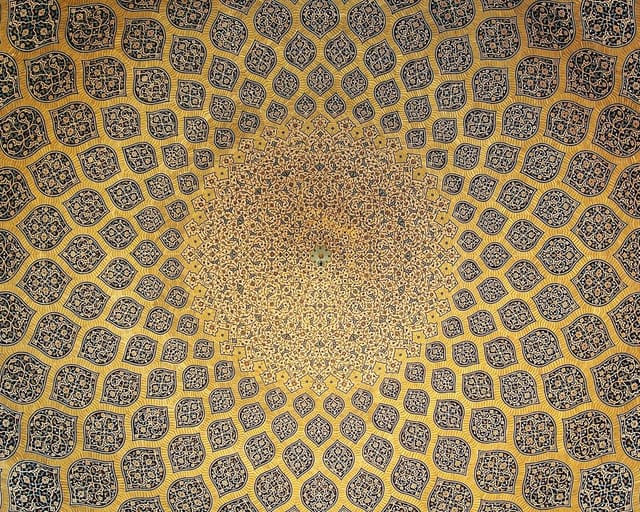
Image: Phillip Maiwald (Nikopol), The inner dome of the Sheikh Lotfollah Mosque, Isfahan, 2008. CC BY-SA 3.0, via Wikimedia Commons.. Image credits
