Is sex reassignment surgery allowed in Islam?
Question 1006
Question
Is it permissible for a transgender Muslim to have sex reassignment surgery or other medical transition, such as hormone therapy?
Summary of answer
Sex reassignment surgery is halal, on the stronger view, when a person chooses it freely on the advice of trustworthy doctors. The Prophet ﷺ commanded his community to seek treatment, Ayatollah Khomeini ruled transition permissible and Iran has recognized it since 1987, and Egypt's Grand Mufti Muhammad Sayyid Tantawi permitted surgery in 1988 when doctors found a bodily cause. The verse on changing Allah's creation (4:119) concerns pagan practices that Satan commands.
Answer
الحمد لله Praise be to Allah.
Many transgender Muslims reach a point where medical transition, hormones or surgery, would let them live in peace in their own bodies. Then they ask whether Allah permits it. The stronger view (al-rājiḥ) is that sex reassignment surgery is halal when a person chooses it freely on the advice of trustworthy doctors. The sharia commands medical treatment and seeks ease for the believer, and two of the most influential Muslim authorities of the twentieth century, one Shia and one Sunni, issued fatwas that opened the way to transition.
Is sex reassignment surgery haram?
The Prophet ﷺ taught his community to seek treatment for whatever afflicts them. When the Bedouin asked him whether they should take medicine, he answered:
«نَعَمْ يَا عِبَادَ اللَّهِ تَدَاوَوْا فَإِنَّ اللَّهَ لَمْ يَضَعْ دَاءً إِلاَّ وَضَعَ لَهُ شِفَاءً»
“Yes, servants of Allah, seek treatment, for Allah has not created any illness without also creating a cure for it.”
Jamiʿ al-Tirmidhi 2038 (graded sahih by al-Albani)
Gender dysphoria, the distress of living in a body that does not match one’s gender, is recognized by medicine, and physicians treat it with care and long assessment. For many transgender people, hormone therapy and surgery relieve that distress and let them pray, work, marry, and serve their communities with a settled heart. The Quran describes the whole sharia in the same spirit:
يُرِيدُ ٱللَّهُ بِكُمُ ٱلۡيُسۡرَ وَلَا يُرِيدُ بِكُمُ ٱلۡعُسۡرَ
“Allah wants ease for you, and does not want hardship for you.”
The ruling on being transgender itself is set out in Is being transgender haram?
What did Ayatollah Khomeini rule?
Ayatollah Ruhollah Khomeini (d. 1989) began his legal manual Taḥrīr al-Wasīla in 1964, in exile in Turkey, and completed it in Iraq. In its section on contemporary questions he included a discussion titled “The Changing of Sex,” where he found no religious objection to the operation.
In 1986 or 1987, Maryam Khatoon Molkara, a transgender woman who had petitioned him for years, came to his home in Tehran to plead her case. After hearing her, Khomeini ruled that she could live as a woman and undergo surgery. Since that fatwa of 1987, Iran has recognized legal gender change, and the state offers grants and loans toward the cost of surgery. Molkara herself completed her surgery in 1997 with state support.
What did Egypt’s mufti and al-Azhar say?
In January 1988, Sally Mursi, a medical student at al-Azhar University, had sex reassignment surgery in Cairo. That same year, Muhammad Sayyid Tantawi, then Grand Mufti of Egypt and later Shaykh al-Azhar, issued a fatwa on her case. He permitted surgery from male to female or female to male when a trustworthy doctor finds innate causes in the body itself. He reasoned in the terms of the classical law on intersex people (khunthā, خنثى): surgery reveals a sex that was hidden and cures a bodily condition. He also wrote that surgery is not permitted at a mere wish to change sex.
In 1989 the Islamic Fiqh Academy of the Muslim World League ruled that intersex people have the right to treatment, surgical or hormonal, and forbade the operation to others. Many Sunni scholars follow that stricter line today. It is a recognized opinion.
The stronger view builds on Tantawi’s own test. Transition today is undertaken only after long medical assessment, on the advice of physicians, for a condition medicine recognizes and treats. That is the trustworthy doctor’s judgment Tantawi asked for, and the duty to seek a cure applies to it as to any other illness.
Does surgery “change the creation of Allah”?
Those who forbid transition usually cite a verse in Sūrat al-Nisāʾ. The words are Satan’s, describing what he will command his followers:
وَلَأٓمُرَنَّهُمۡ فَلَيُبَتِّكُنَّ ءَاذَانَ ٱلۡأَنۡعَٰمِ وَلَأٓمُرَنَّهُمۡ فَلَيُغَيِّرُنَّ خَلۡقَ ٱللَّهِ
“I will command them, and they will slit the ears of cattle; I will command them, and they will change the creation of Allah.”
The verse names a pagan rite: the Arabs slit the ears of certain camels and dedicated them to idols, a practice the Quran condemns again in 5:103. Early exegetes offered several meanings for “the creation of Allah,” and the great Tunisian commentator Ibn ʿĀshūr (d. 1973) held that a change is sinful only when it carries some obedience to Satan; he excluded whatever Allah permits, such as circumcision for health. Jurists who permitted the operation objected that a literal reading would forbid countless ordinary acts that the law permits. Muslims circumcise, set bones, remove organs to save lives, and receive transplants, and none of these is a change made at Satan’s command. Medical care sought for healing belongs to the same family.
How should a Muslim approach transition?
- Work with qualified doctors. Transition is a medical path, and its safety depends on careful assessment and follow-up.
- Choose freely. Surgery is one option among several, and no one should be pushed toward it or away from it, by family, community, or the state.
- Pray the istikhāra prayer before a major decision, as the Prophet ﷺ taught for every important matter (Sahih al-Bukhari 6382).
- Care for your heart. Transition can be a hard road; a counselor who respects your faith helps, and seeking support is part of faith (Is depression a sign of weak iman?).
- Find community. Inclusive mosques welcome trans Muslims in their rows (Are there LGBTQ-friendly and inclusive mosques?), and parents owe their trans children the mercy they owe every child (Is it permissible to disown your child for being gay?).
Young people in the US can reach The Trevor Project at any hour, and Hidayah supports LGBT+ Muslims in the UK.
A closing duʿāʾ
The prayer of seeking guidance begins with words every believer can carry into a hard decision:
«اللَّهُمَّ إِنِّي أَسْتَخِيرُكَ بِعِلْمِكَ، وَأَسْتَقْدِرُكَ بِقُدْرَتِكَ، وَأَسْأَلُكَ مِنْ فَضْلِكَ الْعَظِيمِ»
“O Allah, I ask You to guide me by Your knowledge, to give me strength by Your power, and I ask You of Your immense bounty.”
May Allah grant every trans believer healing, ease, and a heart at rest in the body He has helped them make their home.
And Allah knows best. والله أعلم
Frequently asked questions
Is hormone therapy haram?
Hormone therapy follows the same ruling as surgery. It is medicine, and the Prophet ﷺ commanded his community to seek treatment, so it is halal when taken under the care of a trustworthy doctor.
Does a trans Muslim have to have surgery?
No. Surgery is a personal and medical decision, and many trans Muslims live their gender with hormones alone or with no medical treatment at all. No one should be pressured toward surgery or away from it.
What is the Shia view on sex change?
Ayatollah Khomeini permitted sex reassignment in his legal manual Taḥrīr al-Wasīla and in a fatwa of 1987, and Iran has recognized legal gender change ever since. That ruling remains the established practice in Iran.
Is surgery for intersex people allowed?
Yes, by the agreement of the major juristic bodies. The Islamic Fiqh Academy of the Muslim World League ruled in 1989 that an intersex person has the right to medical treatment, surgical or hormonal.
Related questions
Sources
- Ruhollah Khomeini, Taḥrīr al-Wasīla (section on contemporary questions, "The Changing of Sex")
- Muhammad Sayyid Tantawi, fatwa on sex-change surgery (Dar al-Iftaʾ al-Misriyya, 1988), discussed in Jakob Skovgaard-Petersen, "Sex Change in Cairo: Gender and Islamic Law," Journal of the International Institute 2, no. 3 (1995)
- Islamic Fiqh Academy of the Muslim World League, resolution of the 11th session, Makkah, 1989
- Ibn ʿAshur, al-Taḥrīr wa-l-Tanwīr (commentary on 4:119)
- Jamiʿ al-Tirmidhi 2038 (seek treatment, for Allah made a cure for every disease)
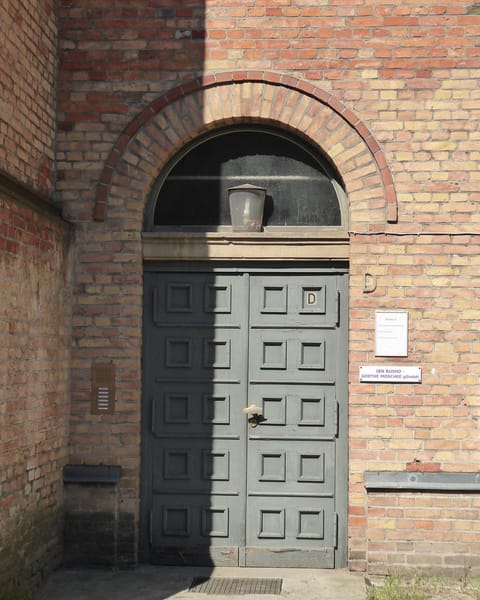
Image: Fridolin freudenfett, Entrance to the Ibn Rushd-Goethe Mosque at the Johanniskirche, Berlin-Moabit, 2017. CC BY-SA 4.0, via Wikimedia Commons.. Image credits
