Is being gay haram?
Question 1001
Question
Is it haram to be gay in Islam, and may a gay Muslim love and build a life with a partner of the same sex?
Summary of answer
Being gay is halal, and the stronger view holds that faithful same-sex relationships are permissible. The Quran condemns the people of Lot for attacking men, robbing travelers, and committing open wrongs in their gatherings (29:29), and it prescribes no worldly punishment for same-sex love. Abu Hanifa refused to treat same-sex intercourse as zina, the death-penalty reports lie outside al-Bukhari and Muslim and their chains were disputed, and the Ottoman code of 1858 set no penalty for private relations.
Answer
الحمد لله Praise be to Allah.
Many gay Muslims first ask whether being gay is haram alone, late at night, afraid of the answer. The answer of the Quran is gentler than they fear. Being gay is halal, and the stronger view (al-rājiḥ) is that same-sex love and faithful same-sex relationships are permissible. The Quran’s story of Lot (peace be upon him) condemns a town that assaulted guests and robbed travelers, and nowhere in the Book does Allah set a worldly punishment for loving someone of the same sex.
Is it haram to be gay in Islam?
Being gay describes whom a person loves and is drawn to. No one chooses it, and the Quran holds no one to account for what lies beyond their power:
لَا يُكَلِّفُ ٱللَّهُ نَفۡسًا إِلَّا وُسۡعَهَا
“Allah does not burden any soul beyond what it can bear.”
Even scholars who hold the strictest view today agree that attraction a person did not choose carries no blame. The Prophet ﷺ said that Allah has pardoned his community for what passes through their hearts (Sahih al-Bukhari 5269). The question that remains concerns relationships, and there the scholars differed (ikhtalafa al-ʿulamāʾ).
The jurists of the four Sunni schools and the Jaʿfari school held same-sex intercourse to be forbidden, and many mosques teach that view today. It is a recognized opinion, held by scholars who love the religion. The stronger view rests on a closer reading of the Quran itself. Scott Siraj al-Haqq Kugle sets it out in Homosexuality in Islam (2010), and imams in Africa, Europe, and North America have taught it for decades. It holds that faithful same-sex relationships, and the marriages that protect them, are halal.
What was the sin of the people of Lot?
Every argument against gay Muslims begins with Lot. The Quran tells his story in several surahs, and its charges are specific. In Sūrat al-ʿAnkabūt, Lot names three crimes in one breath:
أَئِنَّكُمۡ لَتَأۡتُونَ ٱلرِّجَالَ وَتَقۡطَعُونَ ٱلسَّبِيلَ وَتَأۡتُونَ فِي نَادِيكُمُ ٱلۡمُنكَرَ
“Do you go after men, rob travelers on the road, and commit outrages in your gatherings?”
The other tellings show what “going after men” meant in that town. When angels came to Lot as guests, the men of the city came rushing to his door (11:78). Lot pleaded with them, “Fear Allah, and do not shame me through my guests.” The Quran says the townsmen “tried to take his guests from him” (54:37), and in Sūrat al-Ḥijr they reproach Lot for sheltering strangers at all (15:70).
Kugle and other readers of the Quran conclude that the story describes a town that used sexual assault to humiliate strangers and robbed those who passed through. A mob that tries to seize two guests has nothing in common with two people who love each other and build a life in faithfulness. The full reading of these passages is in What does the Quran say about homosexuality?
Does Islamic law punish same-sex relations?
The Quran sets fixed penalties for a few acts, such as theft and zina. It sets none for same-sex relations. Abu Hanifa (d. 767), founder of the most widely followed school of Islamic law, refused to treat same-sex intercourse as zina, so in his view no fixed (ḥadd) punishment applied. The jurists disagreed so widely that al-Tirmidhi (d. 892) recorded their conflicting opinions beside the hadith he narrated on the subject (Jamiʿ al-Tirmidhi 1456).
The reports that prescribe death are absent from Sahih al-Bukhari and Sahih Muslim. Al-Tirmidhi noted that the report from Ibn ʿAbbās is known through only one chain, and that a parallel report from Abū Hurayra rests on a narrator whose memory was weak. Hadith critics have disagreed about these reports ever since: al-Albani (d. 1999) graded the first one sound, and others have pointed to the weaknesses in it. The jurists’ own principle is to avert fixed punishments whenever doubt exists, and the hudud are in any case not for application today (What are hudud punishments?).
History bears this out. When the Ottoman Empire, whose courts followed the Hanafi school, issued its penal code of 1858, it set no penalty for private same-sex relations; its article on the matter punished only public indecency.
Can you be gay and Muslim?
Muslims on every continent have answered yes with their lives. Muhsin Hendricks (1967–2025), an imam in Cape Town, came out in 1996, founded The Inner Circle to support gay Muslims, and officiated their marriages from 1998 until his death. Daayiee Abdullah (1954–2025) served as an imam to gay Muslims in Washington, D.C. Ludovic-Mohamed Zahed opened an inclusive prayer room in Paris in 2012, and in 2017 he led Friday prayer at the Ibn Rushd-Goethe Mosque in Berlin, founded by the lawyer and imam Seyran Ateş.
Prayer, fasting, zakat, and pilgrimage belong to a gay Muslim as fully as to anyone. The Prophet ﷺ taught where Allah’s gaze rests:
«إِنَّ اللَّهَ لاَ يَنْظُرُ إِلَى صُوَرِكُمْ وَأَمْوَالِكُمْ وَلَكِنْ يَنْظُرُ إِلَى قُلُوبِكُمْ وَأَعْمَالِكُمْ»
“Allah does not look at your forms or your wealth. He looks at your hearts and your deeds.”
Mosques that welcome gay Muslims openly now exist in many cities (Are there LGBTQ-friendly and inclusive mosques?), and two Muslims of the same sex can marry with a nikah (Can two Muslims of the same sex marry?).
What if my family or community rejects me?
Many gay Muslims carry fear of their families more than fear of Allah. Parents owe their children mercy, support, and closeness in every view of this question, and cutting off a child for being gay is haram (Is it permissible to disown your child for being gay?). Keep the door open where it is safe, and protect yourself where it is not.
You do not have to carry this alone. Muslims for Progressive Values offers community in North America, Hidayah supports LGBT+ Muslims in the UK, and young people in the US can reach The Trevor Project at any hour.
A closing word
The same Lord who made you also made the heart that loves. His promise to His servants is wide enough for every one of them:
وَرَحۡمَتِي وَسِعَتۡ كُلَّ شَيۡءٖ
“My mercy embraces all things.”
Pray, give, fast, and love faithfully. May Allah fill your home with tranquility, and gather you and those you love under His mercy.
And Allah knows best. والله أعلم
Frequently asked questions
Is it haram to have gay feelings?
No. Attraction is part of how a person is made, and even scholars who hold the strictest view today agree that feelings a person did not choose carry no blame. Allah asks of each soul only what it can bear (2:286).
Is being lesbian haram?
The ruling is the same: love between women and faithful relationships between women are halal. The Quran nowhere names love between women; a few exegetes read 4:15 that way, while most read it as a verse about zina between a man and a woman.
Can a gay Muslim pray and go to the mosque?
Yes. Prayer, fasting, and every act of worship belong to every Muslim, and the Prophet ﷺ taught that Allah looks at hearts and deeds. Many mosques welcome gay Muslims openly.
What does the Hanafi school say?
Abu Hanifa refused to class same-sex intercourse as zina, so in his view no fixed hadd punishment applied. Classical Hanafi jurists still counted the act as forbidden; the stronger view today, built on a close reading of the Quran, holds faithful same-sex relationships to be halal.
What is the Shia view?
Jaʿfari jurists, like the four Sunni schools, historically forbade same-sex intercourse. The Quranic evidence discussed in this answer belongs to Sunni and Shia Muslims alike, and it leads to the same ruling in both.
Related questions
Sources
- Scott Siraj al-Haqq Kugle, Homosexuality in Islam: Critical Reflection on Gay, Lesbian, and Transgender Muslims (Oneworld, 2010)
- Jamiʿ al-Tirmidhi 1456, with al-Tirmidhi's notes on its chain and on the jurists' disagreement
- Sahih Muslim 2564c (Allah looks at your hearts and your deeds)
- Ottoman Penal Code of 1858, Article 202
- Muslims for Progressive Values
- Hidayah (support for LGBT+ Muslims in the UK)
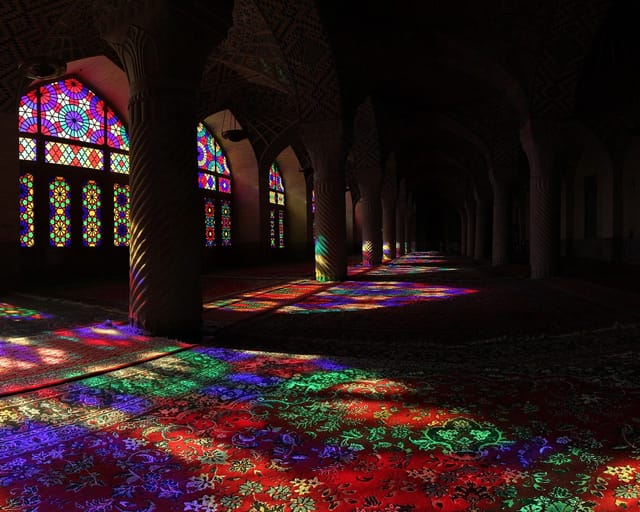
Image: Ayyoubsabawiki, Morning light in the Nasir al-Mulk Mosque, Shiraz, 2015. CC BY-SA 4.0, via Wikimedia Commons.. Image credits
