Is burning incense haram?
Question 1269
Question
Is it permissible for a Muslim to burn incense at home, such as incense sticks, bakhoor, oud, or sage, and to be around incense in a church or temple?
Summary of answer
Burning incense is halal and follows a sunna of fragrance. The Prophet ﷺ said perfume was made dear to him, and Ibn Umar burned pure aloeswood, saying this was how the Messenger of Allah ﷺ perfumed himself (Sahih Muslim 2254). Bakhūr, oud, frankincense, incense sticks, and sage are lawful scents. A Muslim leaves aside only incense offered to an idol as worship, and smoke that harms someone's lungs.
Answer
الحمد لله Praise be to Allah.
A box of sandalwood sticks from the Asian grocery, a chip of bakhūr glowing on charcoal at a grandmother’s house, a bundle of sage from a wellness shop, the cloud of frankincense at a neighbor’s church funeral: many Muslims wonder whether burning incense is haram. It is halal, and it carries a sunna. The Prophet ﷺ loved good scent, and his Companion Ibn Umar (may Allah be pleased with him) burned pure aloeswood and said that this was how the Messenger of Allah ﷺ perfumed himself.
The tradition sets apart one act only: incense offered to an idol or a deity as worship. The fragrance itself, from whatever shop or land it comes, belongs to the good things Allah made lawful.
Is burning incense haram in Islam?
The jurists’ starting rule is that the things of everyday life are permissible (al-aṣl fī al-ashyāʾ al-ibāḥa, الأصل في الأشياء الإباحة) until a text forbids them, and no verse or sound hadith forbids incense. The Quran asks:
قُلۡ مَنۡ حَرَّمَ زِينَةَ ٱللَّهِ ٱلَّتِيٓ أَخۡرَجَ لِعِبَادِهِۦ وَٱلطَّيِّبَٰتِ مِنَ ٱلرِّزۡقِ
“Say: who has forbidden the adornment that Allah brought forth for His servants, and the good things He provides?”
Fragrance was among the things the Prophet ﷺ loved most in this world:
«حُبِّبَ إِلَىَّ مِنَ الدُّنْيَا النِّسَاءُ وَالطِّيبُ وَجُعِلَ قُرَّةُ عَيْنِي فِي الصَّلاَةِ»
“From this world, women and perfume were made dear to me, and my delight was set in prayer.”
Al-Albani graded this hadith hasan sahih. Incense was part of that love. Nāfiʿ, the freed servant of Ibn Umar, described his master’s habit:
«كَانَ ابْنُ عُمَرَ إِذَا اسْتَجْمَرَ اسْتَجْمَرَ بِالأَلُوَّةِ غَيْرِ مُطَرَّاةٍ وَبِكَافُورٍ يَطْرَحُهُ مَعَ الأَلُوَّةِ ثُمَّ قَالَ هَكَذَا كَانَ يَسْتَجْمِرُ رَسُولُ اللَّهِ صلى الله عليه وسلم»
“Whenever Ibn Umar perfumed himself with incense, he burned aloeswood on its own, unblended, or with camphor dropped in among the aloeswood. Then he said: This is how the Messenger of Allah ﷺ used to perfume himself with incense.”
Aloeswood (alūwwa) is the resinous heartwood that Arabic also calls ʿūd and English calls oud or agarwood.1
Can Muslims burn bakhūr and oud at home and in the mosque?
Mosques were among the first places Muslims perfumed. Aisha reported that the Prophet ﷺ commanded mosques to be built in every neighborhood, kept clean, and perfumed (Sunan Abi Dawud 455, graded sahih by al-Albani). One of the Followers who narrates from Abu Hurayra in Sahih al-Bukhari is known to history as Nuʿaym al-Mujmir, “Nuʿaym of the censer.” Al-Dhahabi (d. 1348) records in Tārīkh al-Islām that he used to perfume the Prophet’s ﷺ mosque with incense, and later biographers say Umar gave him the task.
The practice continues. Across the Arab world, hosts pass the censer (mabkhara) among guests in the majlis as a sign of welcome, and families scent their homes and clothes with bakhūr on Fridays and at weddings. Each year the Kaaba is washed with Zamzam water, rose water, and oud oil. The frankincense (lubān) burned in many of these homes grows in southern Arabia, where Oman’s frankincense groves and ancient trading ports were inscribed by UNESCO in 2000 as the Land of Frankincense.
Women burn bakhūr as freely as men. The one report about incense and the night prayer is explained in Can Muslim women wear perfume?
Are incense sticks from an Asian shop haram?
Many Muslims in Europe buy incense sticks at an Asian supermarket or a tea shop. Many of these sticks are made for Buddhist, Taoist, or Hindu altars, and the question follows: does that origin make them haram to buy or burn?
It does not. A stick of sandalwood or jasmine is a fragrant object with no faith of its own. The Prophet ﷺ taught that “deeds are judged only by their intentions” (Sahih al-Bukhari 1). Lit on a bookshelf to scent a room, during study, or to welcome guests, it is the same lawful fragrance as bakhūr, and buying it from a shopkeeper of another faith is ordinary, lawful trade.
What a Muslim leaves aside is incense offered as worship: a stick lit before a statue as an offering, with a bow or a prayer to that image. Worship belongs to Allah alone:
قُلۡ إِنَّ صَلَاتِي وَنُسُكِي وَمَحۡيَايَ وَمَمَاتِي لِلَّهِ رَبِّ ٱلۡعَٰلَمِينَ
“Say: my prayer, my rites of devotion, my living and my dying belong to Allah, Lord of the worlds.”
Is burning sage or smudging haram?
Bundles of white sage are sold across Europe and North America for “smudging.” Many Indigenous peoples of North America burn sage and other herbs in ceremonies of blessing, and Native communities have objected to the commercial trade and to the over-harvesting of wild white sage.
As a fragrance, sage is one of Allah’s sweet-smelling herbs. The Prophet ﷺ said: “Whoever is offered a fragrant herb (rayḥān) should not refuse it, for it is light to carry and sweet of scent” (Sahih Muslim 2253). Burning sage to freshen a room or for its scent is halal. A Muslim who buys it can choose cultivated sage and treat the ceremonies of Indigenous peoples with respect.
The wellness trade often adds a promise that the smoke clears “negative energy” or drives away spirits. No sound hadith gives smoke such a power. Persian households have long burned esfand (wild rue) seeds against the evil eye, a custom that Encyclopaedia Iranica finds widely attested in classical Persian literature. Such smoke is a pleasant custom. Protection comes from Allah alone, and the Prophet ﷺ taught the believers to seek it with the last two suras of the Quran:
قُلۡ أَعُوذُ بِرَبِّ ٱلۡفَلَقِ ﴿١﴾ مِن شَرِّ مَا خَلَقَ ﴿٢﴾
“Say: I seek refuge with the Lord of the daybreak from the evil of what He has created.”
Light the sage for its scent, and recite al-Falaq and al-Nās for protection. More on this in Is the evil eye real? and in the answer on superstitions and Islam.
Can Muslims be around incense in a church or temple?
Catholic and Orthodox churches burn frankincense at Mass, at Christmas, and at funerals, and Hindu and Buddhist temples fill with the smoke of incense sticks. A Muslim who attends a neighbor’s funeral, a friend’s wedding, a school visit to a temple, or a Diwali evening breathes that scent as a guest, and his or her faith is untouched by it. The Quran counts churches and synagogues among the houses of worship that Allah protects (Quran 22:40).
The offering belongs to the worshippers. A Muslim guest stands with courtesy and steps back politely if invited to swing the censer or set a stick before an image. Guidance for these visits is in Can Muslims enter or pray in a church? and Can Muslims visit a Hindu temple or celebrate Diwali?
Is incense safe for health?
The sharia protects life and health, and the Prophet ﷺ ruled that “there is to be no harm and no harming” (Sunan Ibn Majah 2340, graded sahih by al-Albani). A 2008 review in Clinical and Molecular Allergy found that incense smoke carries fine particles and gases that burden the airways, with more particulate matter per gram burned than cigarettes, and advised ventilating homes where incense is burned.
- Air the room. Open a window and burn for a short while.
- Mind the lungs of others. Keep smoke away from babies, and ask before burning near anyone with asthma.
- Mind the fire. Set the burner on a heatproof surface and never leave charcoal or a lit stick alone.
- Keep it light in shared spaces. In a mosque or a shared flat, a gentle scent serves everyone better than a heavy cloud.
A closing word
The Prophet ﷺ described the people of Paradise, their hearts as one heart, glorifying Allah morning and evening, and he said:
«وَقُودُ مَجَامِرِهِمُ الأُلُوَّةُ»
“The fuel of their censers is aloeswood.”
Every chip of oud on the coals is a small reminder of that promise. Burn it with gratitude, let it scent your prayer and your welcome, and ask Allah for the Garden where the censers burn aloeswood.
Footnotes
Istijmār here means scenting oneself with smoke over embers (jamr). In the chapters on purity the same verb names cleaning with small stones, and the context decides. In Bukhari’s version of the Paradise hadith, the narrator Abu al-Yamān explains alūwwa as ʿūd. ↑
And Allah knows best. والله أعلم
Frequently asked questions
Does burning incense break the fast?
Burning incense in the room and catching its scent do not break the fast. Hanafi jurists, following al-Shurunbulālī's Marāqī al-Falāḥ, hold that deliberately drawing the smoke into the nose or mouth does, so many fasting families light the bakhūr after iftar.
Can women burn bakhoor?
Yes. Women perfume their homes, clothes, and hair with bakhūr across the Muslim world. One report in Sahih Muslim (444) asked women scented with incense to stay away from the night prayer at the mosque, and scholars tie it to the dark lanes of Medina.
What is the Shia view on incense?
Jaʿfari jurists count perfume among the recommended sunnas of the prophets, and al-Hurr al-ʿĀmilī's hadith collection Wasāʾil al-Shīʿa gathers reports recommending incense.
Can you burn incense for someone who has died?
Perfuming the clothes of the deceased with incense is an old practice. Asmāʾ bint Abī Bakr asked her family to perfume her clothes with incense when she died, and asked them not to follow her bier with fire (Muwatta Malik 531).
Can I burn incense while I pray or read the Quran?
Yes. Scenting the place of prayer follows the Prophet's ﷺ command that mosques be kept clean and perfumed (Sunan Abi Dawud 455), and many families burn bakhūr before the Friday prayer.
Related questions
Sources
- Sahih Muslim 2253 and 2254
- Sunan al-Nasa'i 3939
- Sunan Abi Dawud 455 and Sahih al-Bukhari 3246
- al-Dhahabi, Tārīkh al-Islām (entry on Nuʿaym ibn ʿAbd Allāh al-Mujmir)
- al-Shurunbulālī, Marāqī al-Falāḥ sharḥ Nūr al-Īḍāḥ
- Lin, Krishnaswamy and Chi, "Incense smoke: clinical, structural and molecular effects on airway disease", Clinical and Molecular Allergy 6 (2008)
- Encyclopaedia Iranica, "Esfand"
- UNESCO World Heritage Centre, Land of Frankincense
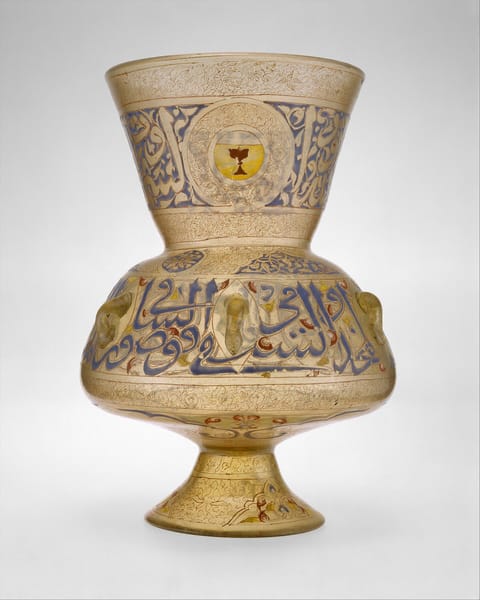
Image: ʿAli ibn Muhammad al-Barmaki, Mosque lamp of Amir Qawsun, Cairo, c. 1329–1335. Metropolitan Museum of Art, New York. CC0, via Wikimedia Commons.. Image credits
