Can Muslims visit a Hindu temple or celebrate Diwali?
Question 1245
Question
Is it permissible for a Muslim to visit a Hindu temple, attend a Diwali party, or wish Hindu friends a happy Diwali?
Summary of answer
Visiting a Hindu temple as a respectful guest and celebrating Diwali with friends and neighbors are permissible. The Quran commands kindness to peaceful people of every faith (60:8), returning greetings with better ones (4:86), and never insulting what others worship (6:108). Muslims in India shared Diwali for centuries, and the emperor Akbar joined its festivities. A Muslim keeps tawḥīd by leaving aside worship before images, such as puja and aarti.
Answer
الحمد لله Praise be to Allah.
Every autumn, Hindu friends string lights across their balconies, fill their kitchens with sweets, and invite their Muslim neighbors to share the festival of Diwali. Hindu colleagues hold weddings in temples, and schools take pupils to visit a mandir. Can Muslims go? The stronger view (al-rājiḥ) is that Muslims may visit a Hindu temple as respectful guests and celebrate Diwali with friends and neighbors: the lights, the sweets, the meals, the greetings, and the gifts. What a Muslim leaves aside is worship directed to an image, such as puja and aarti. Tawḥīd is kept in the heart and in the act of worship, and it is never threatened by sharing a neighbor’s joy.
Can Muslims visit a Hindu temple?
The Quran speaks of houses of worship with respect. It names “monasteries, churches, synagogues, and mosques, where the name of Allah is much remembered” among the places Allah protects (Quran 22:40), and it forbids Muslims to insult what others worship (6:108). Muslims may enter a church and even pray in one (Can Muslims go to church?). A Hindu temple differs because its worship centers on images of the divine, so a Muslim does not perform his own prayer before them. Visiting to learn, to attend a friend’s wedding or memorial, to accompany a school group, or to admire the architecture is another matter, and it is permissible.
Muslim scholars have long studied Hindu worship from close up. Al-Bīrūnī (d. c. 1050) learned Sanskrit, read the scriptures with Hindu scholars, and described the Hindu festivals of his day, including the feast of lamps at the new moon of Kārttika, in his Taḥqīq mā li-l-Hind.
How to visit a temple respectfully
- Remove your shoes and dress modestly, as you would in a mosque.
- Ask before photographing, and do not touch shrines or images.
- Follow your hosts’ guidance about where guests may stand.
- Step back politely if a priest offers a blessing such as the aarti flame or a tilak mark; hosts understand that guests of other faiths have their own practice.
Can Muslims celebrate Diwali?
Diwali, the festival of lights, holds different meanings for different communities. For many Hindus it marks the return of Rama to Ayodhya and honors Lakshmi, the goddess of prosperity; Sikhs celebrate the release of Guru Hargobind on the same days, and Jains remember the liberation of Mahavira. Its public face is lamps, sweets, new clothes, fireworks, and family visits.
Muslims in India have shared that public face for centuries. The Mughal emperor Akbar welcomed and took part in the festivities, and the Mughal court kept its own celebration of lamps, known as Jashn-e-Chiraghan. In 2016 Pakistan’s National Assembly adopted a resolution declaring Diwali, Holi, and Easter public holidays for the country’s religious minorities.
The Quran’s rule for neighbors of other faiths is kindness and justice (Quran 60:8), and its rule for greetings is generosity:
وَإِذَا حُيِّيتُم بِتَحِيَّةٖ فَحَيُّواْ بِأَحۡسَنَ مِنۡهَآ أَوۡ رُدُّوهَآ
“When you are greeted with a greeting, greet back with something better, or at least return it.”
A Muslim may therefore wish friends a happy Diwali, accept and give sweets, light lamps at a party, admire the rangoli, watch the fireworks, and sit down to a family meal. The same reasoning applies to Christmas (Is it haram for Muslims to celebrate Christmas?) and to Holi, Navratri, and Pongal.
What about the food?
The Quran’s prohibitions on food concern pork, blood, carrion, and animals slaughtered in the name of other than Allah (2:173; 5:3). Diwali sweets made in a friend’s kitchen are lawful gifts. Food formally offered before an image as prasad is a matter on which the scholars differ; a Muslim who prefers can thank the host warmly and decline that portion.
Does joining Diwali compromise tawhid?
Sharing a neighbor’s happiness is an act of good character, and it is a different act from worship. The Quran draws the line in Sūrat al-Kāfirūn, which ends:
لَكُمۡ دِينُكُمۡ وَلِيَ دِينِ
“To you your religion, and to me mine.”
The Prophet ﷺ declined to exchange acts of worship with the idolaters of Mecca, and he kept close social ties with relatives who still worshipped idols. When Asmāʾ’s mother came to visit her while still a polytheist, he told Asmāʾ to keep the bond (Sahih al-Bukhari 2620). A Muslim who bows only to Allah can laugh, eat, and light lamps with Hindu friends with a clear conscience. What shirk means, and what it does not, is explained in What is shirk?, and the wider relationship in What does Islam say about Hindus and Buddhists?
A closing word
Allah made humanity into “peoples and tribes so that you may come to know one another” (49:13). Knowing one another happens at a neighbor’s table, in a friend’s wedding hall, and on a street full of lamps. Go as a guest, bring sweets of your own, and invite your friends back for Eid.
And Allah knows best. والله أعلم
Frequently asked questions
Can Muslims say 'Happy Diwali'?
Yes. Wishing a friend joy on their festival is a courtesy the Quran encourages: 'When you are greeted, greet back with something better' (4:86). Many Muslims send Diwali greetings and receive Eid greetings in return.
Can Muslims eat prasad or Diwali sweets?
Sweets and dishes shared by friends at Diwali are lawful gifts. Food formally offered before an image as prasad is a matter on which scholars differ; a Muslim who prefers can thank the host and decline it.
Can Muslims play Holi?
Joining friends in the colors and celebrations of Holi stands on the same ground as Diwali: it is permissible as a guest and neighbor, leaving aside rites of worship and any intoxicants such as bhang.
Can Muslims light diyas for Diwali?
Lighting lamps to share a friend's joy or to decorate a home is permissible. A Muslim does not place a lamp before an image as an act of worship.
Related questions
Sources
- al-Bīrūnī, Taḥqīq mā li-l-Hind (Alberuni's India), on the festival of lamps in Kārttika
- Egypt's Dar al-Ifta, Ruling on a Muslim praying in a church (13 October 2020)
- Sahih al-Bukhari 2620 (keeping ties with a relative of another faith)
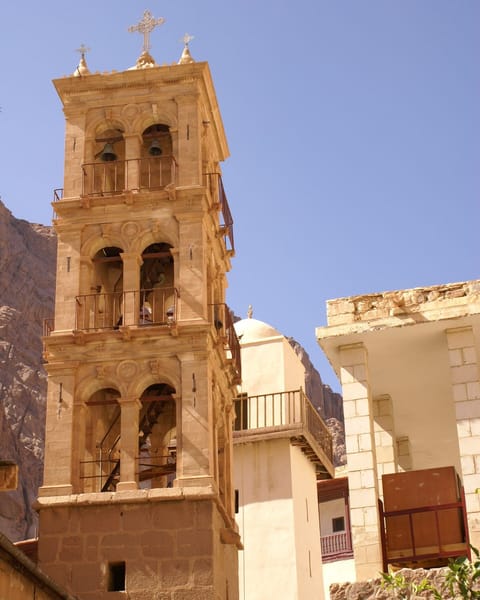
Image: Florian Prischl, Bell tower and minaret, Saint Catherine's Monastery, Sinai, 2007. CC BY-SA 3.0, via Wikimedia Commons.. Image credits
