Can Muslims serve in the military or police of a non-Muslim country?
Question 1181
Question
Is it permissible for a Muslim to join the armed forces or the police in a country that is not governed by Muslims, such as the US or the UK?
Summary of answer
Serving in the military or police of a non-Muslim country is halal. The Quran commands believers to stand firm for justice (4:135), Joseph served the king of Egypt, and the first Muslim emigrants lived under the protection of the Christian Negus. The Fiqh Academy affirmed in 2005 that citizenship in the West agrees with Islamic commitment. One limit binds every soldier and officer: the Prophet ﷺ taught that there is no obedience in sin.
Answer
الحمد لله Praise be to Allah.
Muslims serve today as soldiers, sailors, pilots, medics, and police officers in Britain, the United States, Canada, France, and many other countries. Young Muslims who feel called to that work often hear that it is forbidden to serve a government that is not Muslim. The sound position is that serving in the military or police of a non-Muslim country is halal. Protecting life, defending the innocent, and upholding the law are honored works in Islam, and a soldier or officer who does them with good intention is rewarded for them. One limit binds every person in uniform: obedience is owed only in what is right.
Can a Muslim join the army or police?
The Quran gives every believer a standing order:
كُونُواْ قَوَّـٰمِينَ بِٱلۡقِسۡطِ شُهَدَآءَ لِلَّهِ وَلَوۡ عَلَىٰٓ أَنفُسِكُمۡ
“Stand firm for justice, as witnesses for Allah, even against yourselves.”
Work that keeps people safe answers that call. The Quran also shows a prophet in the service of a king who did not share his faith. Joseph (peace be upon him) asked the ruler of Egypt to place him over the storehouses of the land, saying, “I am a knowing guardian” (Quran 12:55), and he used that office to save a whole region from famine.
The first Muslim emigrants lived for years in Abyssinia under the protection of its Christian king, the Negus, and when he died the Prophet ﷺ told his Companions, “A righteous man has died today,” and led the funeral prayer for him (Sahih al-Bukhari 3877). In 2005 the International Islamic Fiqh Academy, meeting in Dubai, resolved that “the requisites of citizenship in the West do not contradict the preservation of the Islamic identity” (Resolution 151). Serving one’s country is among those requisites.
What about the verses on taking non-Muslims as allies?
Some scholars forbid service in a non-Muslim army, citing the verses that tell believers not to take Jews and Christians as allies (5:51). The scholars of tafsīr connected those verses to the wars of Medina and to alliances with parties fighting the believers. The Quran draws the line itself: Allah does not forbid kindness and justice toward those who have not fought the believers over their faith or driven them from their homes (Quran 60:8). A Muslim who serves the country where he lives, alongside neighbors who protect his mosque and his family, stands within that verse (Can Muslims be friends with non-Muslims?, Can Muslims live in non-Muslim countries?).
What if I am ordered to do something wrong?
The Prophet ﷺ once sent out a detachment under a commander who lit a fire and ordered his men to walk into it. Some were ready to obey; others refused. When the matter reached the Prophet ﷺ, he said that those who had been ready to enter would never have come out, and he praised those who refused:
«لاَ طَاعَةَ فِي مَعْصِيَةٍ، إِنَّمَا الطَّاعَةُ فِي الْمَعْرُوفِ»
“There is no obedience in sin. Obedience is only in what is right.”
This hadith is the conscience of every Muslim in uniform. The Quran permits fighting those who fight and forbids transgression (2:190). The Prophet ﷺ forbade the killing of women and children in war (Sahih al-Bukhari 3015). An order to torture a prisoner, to harm civilians, or to abuse a suspect binds no one. Where a war seems unjust, a Muslim may seek a non-combat post or conscientious objector status where the law allows it. The boxer Muhammad Ali refused induction into the US Army in 1967 on grounds of his faith, and the Supreme Court overturned his conviction in 1971. The measure in every case is justice, whoever the enemy is, as the meaning of struggle in Allah’s way is explained in What is jihad?
Is police work halal?
Policing has deep roots in Muslim history: the early caliphates had a police force (shurṭa) and market inspectors (muḥtasib) who guarded weights and measures and protected the public. The Prophet ﷺ told his Companions to help their brother whether he was wronged or doing wrong, and when they asked how one helps a wrongdoer, he said, “By stopping him from wronging others” (Sahih al-Bukhari 2444).
The same Sunnah sets limits on power. When the Companion Hishām ibn Ḥakīm found tax officials in Syria making men stand in the sun as punishment, he told them he had heard the Prophet ﷺ say, “Allah will torment those who torment people in this world,” and the governor ʿUmayr ibn Saʿd ordered the men released (Sahih Muslim 2613c). A Muslim officer protects the weak, treats suspects with dignity, and refuses abuse, and in doing so he serves his community and wins its trust.
Muslims who served with honor
Muslims have served in non-Muslim armies for well over a century. Khudadad Khan, a Muslim soldier from Punjab, became the first Indian soldier awarded the Victoria Cross, for holding his position in Belgium in 1914. Noor Inayat Khan, a Muslim woman raised in a Sufi family, worked as a British radio operator in occupied Paris during the Second World War, was captured and executed in 1944, and was awarded the George Cross after her death. Their courage was given to protecting others from tyranny, which is the noblest purpose of any armed service (Is Islam a religion of peace?).
A prayer for those who serve
When the believers under Saul (Ṭālūt) went out to face Goliath’s army, they prayed:
رَبَّنَآ أَفۡرِغۡ عَلَيۡنَا صَبۡرٗا وَثَبِّتۡ أَقۡدَامَنَا
“Our Lord, pour patience upon us and make our feet firm.”
May Allah keep every Muslim who serves just in command, merciful in power, firm in conscience, and safe in returning home. A Muslim’s civic duty also reaches the ballot box (Is voting haram?).
And Allah knows best. والله أعلم
Frequently asked questions
Is it haram to be a police officer?
No. Protecting people from harm and stopping wrongdoers is honored work in Islam. The Prophet ﷺ told his Companions to help an oppressor by stopping him from oppressing (Sahih al-Bukhari 2444). An officer must never abuse or torture anyone, whatever an order says.
What if my country goes to war against a Muslim country?
The duty is the same in every war: a Muslim may defend the innocent and must never take part in injustice, whoever the enemy is. A service member who believes a war is unjust may seek a non-combat post or apply as a conscientious objector where the law allows.
Can Muslims pray and fast in the military?
Yes. Armed forces in the US, UK, and many other countries make room for prayer, fasting, halal rations, and religious holidays, and some appoint Muslim chaplains. A soldier on duty or on the move may shorten and combine prayers like a traveler.
Can a Muslim woman join the army or police?
Yes. Women such as Nusayba bint Kaʿb defended the Prophet ﷺ at Uhud, and women serve today in every branch of the armed forces and police.
Related questions
Sources
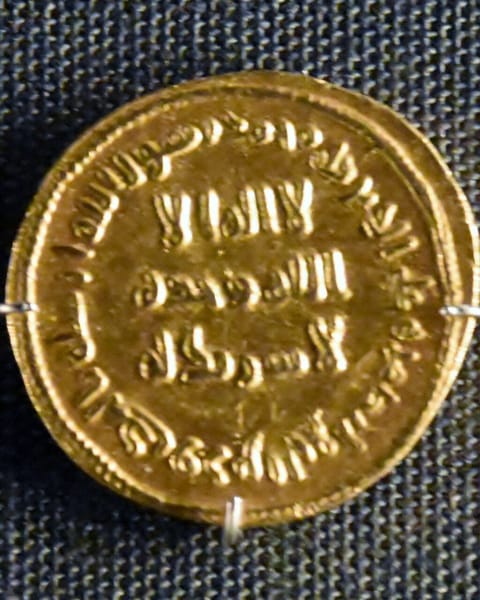
Image: Richard Mortel, Gold dinar of ʿAbd al-Malik ibn Marwan, dated AH 78 (697–698), 2017. David Collection, Copenhagen. CC BY 2.0, via Wikimedia Commons.. Image credits
,_The_David_Collection,_Copenhagen_(36240895662).jpg)