Why do women inherit half in Islam?
Question 1061
Question
Why does Islamic inheritance give a daughter half the share of a son, and can Muslim families or states give women equal shares?
Summary of answer
The Quran's rule of a double share for a son applies to children and siblings, in a system where men paid the dowry and carried all the family's expenses while women kept their wealth for themselves. In other cases women inherit equally or more. Since the rule served justice, families may give daughters equal shares through lifetime gifts, which most jurists say should be equal among children, and several Muslim jurists and states have moved toward equal inheritance.
Answer
الحمد لله Praise be to Allah.
The question is a fair one, and the answer begins with what the Quran did for women. Before Islam, many Arabs gave women little or no inheritance. The Quran gave every daughter, wife, mother, and sister a fixed share that no relative could take away. The double share for a son applies in particular cases, and it was set inside a family system in which men carried every financial duty and women kept their wealth for themselves. The sound position is that these shares served justice (ʿadl), and that Muslim families today may use the means the sharia itself provides to give daughters an equal portion.
What did the Quran change for women?
The first verse of the inheritance passage announces a principle that was new in Arabia:
لِّلرِّجَالِ نَصِيبٞ مِّمَّا تَرَكَ ٱلۡوَٰلِدَانِ وَٱلۡأَقۡرَبُونَ وَلِلنِّسَآءِ نَصِيبٞ مِّمَّا تَرَكَ ٱلۡوَٰلِدَانِ وَٱلۡأَقۡرَبُونَ مِمَّا قَلَّ مِنۡهُ أَوۡ كَثُرَۚ نَصِيبٗا مَّفۡرُوضٗا
“Men have a share of what parents and close relatives leave, and women have a share of what parents and close relatives leave, whether little or much: a share made obligatory.”
Women became heirs by right, with shares fixed by Allah. The Quran also made the marriage gift (mahr) the bride’s own property (4:4) and gave women ownership of their earnings (4:32), part of a wider reform described in What does the Quran say about women?
When do women inherit half?
The verse that sets the double share is Quran 4:11: “Allah instructs you concerning your children: for a son, the like of the share of two daughters.” The same rule applies to full and paternal brothers and sisters (4:176). It does not govern every woman in every estate:
- Parents. When the deceased leaves children, the mother and father each take one sixth (4:11).
- Maternal half-siblings. Brothers and sisters through the mother share equally (4:12).
- Daughters alongside male relatives. A woman who leaves two daughters, her husband, and a brother leaves each daughter a third of the estate, her husband a quarter, and her brother the remaining twelfth.
Why did sons receive a double share?
Classical scholars explained the double share by the duties the law placed on men. A husband paid the mahr. He was responsible for the housing, food, and clothing (nafaqa) of his wife and children, and often of his widowed mother and unmarried sisters, while his wife’s property, earnings, and inheritance remained entirely hers, with no duty to spend any of it on the household. A son received more because he was expected to spend more on others. Umm Salama (may Allah be pleased with her) raised the question in her own day, telling the Prophet ﷺ that men went on campaigns and women did not, “and we have only half the inheritance”; the report says Allah answered with 4:32, which gives each sex its own earnings (Jami’ al-Tirmidhi 3022).
The rule rested on a structure, and the structure has changed in many families. Women now earn wages, support parents, and pay household costs, often with no one maintaining them. The Quran’s command is justice:
إِنَّ ٱللَّهَ يَأۡمُرُ بِٱلۡعَدۡلِ وَٱلۡإِحۡسَٰنِ وَإِيتَآيِٕ ذِي ٱلۡقُرۡبَىٰ
“Allah commands justice, excellence, and giving to relatives.”
When the reason for a ruling (ʿilla) changes, faithful scholars ask how its purpose is best served. The objectives of the sharia (maqāṣid al-sharīʿa) point toward equal outcomes where women carry equal burdens.
Can families give daughters an equal share?
They can, through means the tradition itself recognizes.
Lifetime gifts
A parent may give property to children during life. When al-Nuʿmān ibn Bashīr’s father gave one son a gift and asked the Prophet ﷺ to witness it, the Prophet ﷺ asked:
«أَعْطَيْتَ سَائِرَ وَلَدِكَ مِثْلَ هَذَا … فَاتَّقُوا اللَّهَ، وَاعْدِلُوا بَيْنَ أَوْلاَدِكُمْ»
“Have you given the rest of your children the same as this? … Then be mindful of Allah, and be just among your children.”
The father took the gift back. Most jurists understood “the same” to mean equal gifts for sons and daughters; Ahmad ibn Hanbal and Muḥammad al-Shaybānī held that gifts should follow the proportions of inheritance. A report from Ibn ʿAbbās adds, “Treat your children equally in gifts; if I were to prefer anyone, I would prefer the women,” and Ibn Hajar graded its chain hasan, though others weakened one of its narrators. Many Muslim parents today give their daughters houses, savings, or shares during life, so that each child ends up with the same. Treating children fairly is discussed further in Is it haram to have a favorite child?
Bequests and agreement among heirs
A will may leave up to a third of an estate to people other than the heirs. The Prophet ﷺ said there is “no bequest for an heir” (Sunan Abi Dawud 2870), and most schools allow such a bequest when the other heirs consent. Brothers who choose to divide an estate equally with their sisters after it passes to them do something the sharia fully permits.
What have Muslim states and scholars done?
Turkey’s civil code of 1926 gave daughters and sons equal shares. The Sudanese thinker Mahmoud Mohamed Taha, in The Second Message of Islam (1967), argued that the Meccan verses carry the Quran’s lasting vision of equal dignity, while many Medinan rulings answered the needs of a seventh-century society; he was executed for his views in 1985. In November 2018 Tunisia’s cabinet approved a draft law to make equal shares the norm while letting families who wished keep the classical shares; parliament never enacted it.
These steps remain debated, and many families follow the classical shares with full devotion. What all can agree on is the Quran’s demand that every daughter receive what is hers, with no brother taking it from her, as still happens in too many places. The wider case for women’s equality is made in Is feminism compatible with Islam?, inheritance across faiths is covered in Can a Muslim inherit from a non-Muslim parent?, and women’s rights in marriage in What is mahr?
Standing firm for justice
يَـٰٓأَيُّهَا ٱلَّذِينَ ءَامَنُواْ كُونُواْ قَوَّـٰمِينَ بِٱلۡقِسۡطِ شُهَدَآءَ لِلَّهِ وَلَوۡ عَلَىٰٓ أَنفُسِكُمۡ أَوِ ٱلۡوَٰلِدَيۡنِ وَٱلۡأَقۡرَبِينَ
“You who believe, stand firm for justice as witnesses for Allah, even against yourselves, your parents, or your relatives.”
May Allah make us just to our daughters and our sons, and bless every family’s wealth with fairness and love.
And Allah knows best. والله أعلم
Frequently asked questions
Do women always inherit half of what men inherit?
No. The half share applies to sons and daughters and to brothers and sisters of the same father. A mother and father each take a sixth when the deceased has children, maternal half-siblings share equally (4:12), and in some estates a daughter receives more than a male relative.
Can a Muslim father give his daughter the same as his son?
Yes. He may give his children gifts during his lifetime, and most jurists hold that such gifts should be equal between sons and daughters, following the Prophet's ﷺ command to be just among one's children.
Can I write a will giving my daughters equal shares?
A will may leave up to a third of the estate to people who are not heirs. A bequest to an heir needs the agreement of the other heirs in most schools, so many families equalize through lifetime gifts or by agreement among the heirs.
What is the Shia view on women's inheritance?
Jaʿfari fiqh also gives a son twice a daughter's share, but it lets daughters exclude more distant male relatives, so a daughter who is an only child can inherit the whole estate. Gifts and agreements among heirs are open to Shia families as well.
Related questions
Sources
- Sahih al-Bukhari 2587 (be just among your children)
- Sunan Abi Dawud 2870 (no bequest for an heir)
- Ibn Hajar al-ʿAsqalani, Fatḥ al-Bārī, on the gifts to children
- Mahmoud Mohamed Taha, The Second Message of Islam, trans. Abdullahi An-Na'im (Syracuse University Press, 1987)
- Baker Institute, Stumbling Block: Inheritance and Women's Rights in Tunisia (2021)
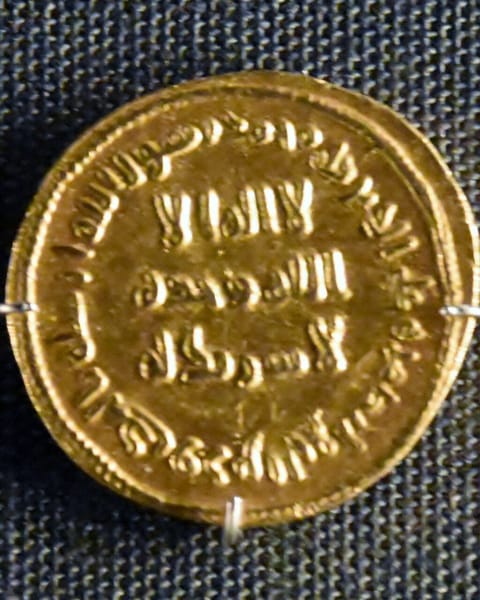
Image: Richard Mortel, Gold dinar of ʿAbd al-Malik ibn Marwan, dated AH 78 (697–698), 2017. David Collection, Copenhagen. CC BY 2.0, via Wikimedia Commons.. Image credits
,_The_David_Collection,_Copenhagen_(36240895662).jpg)