What does Islam say about intersex people?
Question 1128
Question
How does Islam view people born with intersex traits, and what did classical Islamic law say about them?
Summary of answer
Intersex people are shaped by Allah in the womb as He wills (3:6) and share the full dignity of the children of Adam (17:70). Classical jurists wrote whole chapters on the khunthā, giving intersex Muslims a place in the prayer rows, a share of inheritance, and a path to marriage, and Ibn Qudāma accepted a person's own word about their inner inclination. Medical care today should serve the person's health, consent, and privacy.
Answer
الحمد لله Praise be to Allah.
Some children are born with bodies that do not fit the usual pattern of male or female: differences in chromosomes, hormones, or anatomy that doctors today call intersex traits. Their parents, and intersex Muslims themselves, often ask what Islam says. The answer is warm and clear. Intersex people are created by Allah with full dignity, and Islamic law knew them by name, the khunthā (خنثى), and wrote rules to give them a place in every part of Muslim life.
Does the Quran mention intersex people?
The Quran describes Allah as the One who forms every human being before birth, each in the way He chooses:
هُوَ ٱلَّذِي يُصَوِّرُكُمۡ فِي ٱلۡأَرۡحَامِ كَيۡفَ يَشَآءُۚ لَآ إِلَٰهَ إِلَّا هُوَ ٱلۡعَزِيزُ ٱلۡحَكِيمُ
“He is the One who shapes you in the wombs as He wills. There is no god but Him, the Almighty, the Wise.”
Sūrat al-Shūrā adds that Allah “creates what He wills” and gives daughters, sons, both, or none as He chooses (Quran 42:49–50). An intersex body is part of that same creative will. Every child of Adam is honored (17:70), and the Prophet ﷺ taught where Allah’s gaze falls:
«إِنَّ اللَّهَ لاَ يَنْظُرُ إِلَى صُوَرِكُمْ وَأَمْوَالِكُمْ وَلَكِنْ يَنْظُرُ إِلَى قُلُوبِكُمْ وَأَعْمَالِكُمْ»
“Allah does not look at your bodies or your wealth. He looks at your hearts and your deeds.”
What did classical Islamic law say about the khunthā?
The jurists of all four Sunni schools wrote chapters on the khunthā, and the Mamluk-era Shafiʿi jurist ʿAbd al-Raḥīm al-Isnawī (d. 1370) devoted a whole treatise to the subject, Īḍāḥ al-Mushkil min Aḥkām al-Khunthā al-Mushkil. They distinguished two cases. A person whose physical signs pointed clearly one way was a khunthā ghayr mushkil and followed the rulings of that sex. A person whose signs remained mixed was a khunthā mushkil, and the rulings below concern this person.
In childhood the jurists looked at how the child passed urine; at puberty they looked at signs such as menstruation, breasts, or a beard. Modern Muslim physicians such as Muhammad Ali al-Bar have argued that these rulings rested on the medicine of their day, which could not examine the gonads, and should be revisited in light of modern medicine. The principle stays the same: the law follows the reality of the person.
Prayer
The Hanafi jurist al-Kāsānī (d. 1191), in Badāʾiʿ al-Ṣanāʾiʿ, gave the order of rows in a mixed congregation as men, then boys, then khunāthā, then women. The khunthā had a recognized place in the mosque. Since a separate row can also expose a person to stares, the kinder practice today is privacy: an intersex Muslim prays in the row that fits the life they live.
Inheritance
The schools differed on the share of the khunthā mushkil. The Hanafis gave the smaller of the two possible shares. The Malikis, and the Hanbalis in most cases, gave half a son’s share plus half a daughter’s share. The Shafiʿis gave the smaller share and held the rest in reserve until the matter became clear or the heirs agreed among themselves.
Marriage
Most jurists held that the marriage of a khunthā mushkil should wait until the person’s sex was clear. The Hanbali master Ibn Qudāma (d. 1223), commenting on al-Khiraqī in al-Mughnī, opened another door. If the person says he is a man and his nature inclines toward women, he may marry a woman, and the same holds in the other direction. Ibn Qudāma explained why the person’s word is trusted: this inclination is “a matter of the soul and of desire that no one else can see.” He compared it to a woman’s word about her own monthly cycle. Eight centuries ago, a great jurist placed the final word on an intersex person’s inner life in that person’s own mouth.
What does Islam say about surgery on intersex children?
The Islamic Fiqh Council of the Muslim World League, at its eleventh session (1409 AH), ruled that a person with signs of both sexes may receive medical treatment, by surgery or hormones, to resolve the ambiguity, “because this is an illness, and treatment aims at its cure; it is no change to the creation of Allah.” The Prophet ﷺ told his Companions, “Seek treatment, for Allah has not created a disease without creating a cure for it” (Sunan Abi Dawud 3855).
Treatment must serve the patient. The Prophet ﷺ also said, “There is to be no harm and no returning of harm” (Sunan Ibn Majah 2341, graded sahih by al-Albani). Many physicians and ethicists now advise that surgery which is not medically urgent should wait, where it is safe to wait, until the person can take part in the decision. This fits the objectives of the sharia (maqāṣid al-sharīʿa) and Ibn Qudāma’s principle that a person knows their own inner self best. The sound position is that care which protects health is a duty, and choices about identity and appearance belong, wherever possible, to the person who will live with them.
How should families and communities treat intersex Muslims?
- Receive the child as a gift. Allah gives as He wills (42:49). An intersex child is no punishment and no shame to the family.
- Guard their privacy. Covering the faults and secrets of others (sitr) is a beloved Sunna, and a person’s body is no one else’s business. The Quran forbids insulting nicknames (وَلَا تَنَابَزُواْ بِٱلۡأَلۡقَٰبِ, 49:11).
- Keep the mosque open. Intersex Muslims belong in the congregation, the Eid prayer, and the study circle. Communities that welcome every believer are described in Are there LGBTQ-friendly and inclusive mosques?.
- Support their own sense of self. Some intersex people live as men, some as women, and some outside those two categories (Is it haram to be nonbinary?). See also Is being transgender haram? and Is sex reassignment surgery allowed in Islam?.
- Stay close. A parent’s bond with a child is a tie of the womb that Allah commanded to be kept (Is it permissible to disown your child?).
A closing word
The Quran says of every human being:
لَقَدۡ خَلَقۡنَا ٱلۡإِنسَٰنَ فِيٓ أَحۡسَنِ تَقۡوِيمٖ
“We created the human being in the finest form.”
The jurists who wrote about the khunthā were making room in the law for people Allah had made. May Allah grant every intersex Muslim a family that cherishes them, a community that honors them, and a heart at peace with the One who shaped them.
And Allah knows best. والله أعلم
Frequently asked questions
Can an intersex Muslim marry?
Yes. The classical jurists allowed an intersex person whose sex was clear to marry accordingly, and the Hanbali jurist Ibn Qudāma accepted the person's own statement about whom they are drawn to. Marriage rests on consent, mahr, and good companionship, and these are open to intersex Muslims like anyone else.
Where does an intersex person pray in the mosque?
Classical Hanafi texts gave the khunthā a row of their own between the men and the women. Today the kinder practice is privacy: an intersex Muslim prays in the row that fits the life they live, and no one has the right to question them about their body.
Is surgery on intersex babies allowed in Islam?
Treatment that protects a child's health is permitted and encouraged. Surgery that is not medically urgent is better delayed, where doctors judge it safe, until the person can take part in the decision, since Islamic law forbids causing harm and trusts a person's own knowledge of themselves.
Is being intersex the same as being transgender?
No. Intersex describes physical sex characteristics present from birth, and transgender describes a person whose gender differs from the sex recorded at birth. Islam honors both, and each has its own answer on this site.
Related questions
Sources
- Ibn Qudāma, al-Mughnī (Book of Marriage, on the khunthā mushkil)
- al-Kāsānī, Badāʾiʿ al-Ṣanāʾiʿ fī Tartīb al-Sharāʾiʿ
- ʿAbd al-Raḥīm al-Isnawī, Īḍāḥ al-Mushkil min Aḥkām al-Khunthā al-Mushkil
- Islamic Fiqh Council of the Muslim World League, 11th session (1409 AH), resolution on sex change and the khunthā
- Paula Sanders, "Gendering the Ungendered Body: Hermaphrodites in Medieval Islamic Law," in Women in Middle Eastern History, ed. Nikki Keddie and Beth Baron (Yale University Press, 1991)
- Sahih Muslim 2564c
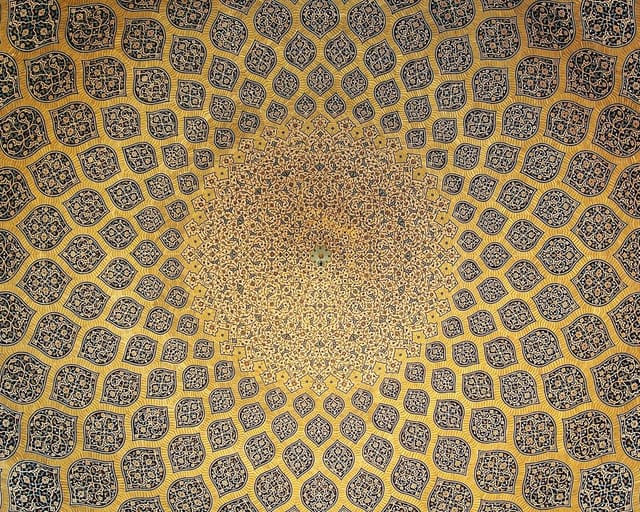
Image: Phillip Maiwald (Nikopol), The inner dome of the Sheikh Lotfollah Mosque, Isfahan, 2008. CC BY-SA 3.0, via Wikimedia Commons.. Image credits
