Is it haram to be nonbinary or use they/them pronouns?
Question 1127
Question
Is it haram in Islam to be nonbinary, and may a Muslim use they/them pronouns or ask others to use them?
Summary of answer
Being nonbinary is halal, and using they/them pronouns is halal. Allah creates what He wills (42:49), and the classical jurists wrote whole chapters on the khunthā, a person who fit neither category neatly, giving them a place in the prayer rows and trusting their own word about their inner nature. The Quran forbids calling people by names they dislike (49:11), so honoring the name and pronouns a person asks for is a Muslim courtesy.
Answer
الحمد لله Praise be to Allah.
Some Muslims experience their gender as something outside the two categories of man and woman, and they ask whether there is room for them in their faith, and whether asking to be called “they” is a sin. The tradition answers with more room than they may expect. Being nonbinary is halal, and using they/them pronouns is halal. Allah creates as He wills, the classical jurists made a place in the law for people who did not fit its two categories, and honoring the name a person asks to be called is part of the courtesy the Quran commands.
Is it haram to be nonbinary in Islam?
A person’s inner sense of their gender is not something they choose, and the Quran reminds us that creation belongs to Allah alone:
لِّلَّهِ مُلۡكُ ٱلسَّمَٰوَٰتِ وَٱلۡأَرۡضِۚ يَخۡلُقُ مَا يَشَآءُۚ يَهَبُ لِمَن يَشَآءُ إِنَٰثٗا وَيَهَبُ لِمَن يَشَآءُ ٱلذُّكُورَ أَوۡ يُزَوِّجُهُمۡ ذُكۡرَانٗا وَإِنَٰثٗاۖ وَيَجۡعَلُ مَن يَشَآءُ عَقِيمًا
“To Allah belongs the dominion of the heavens and the earth. He creates whatever He wills. He grants daughters to whom He wills and sons to whom He wills, or gives both sons and daughters, and He leaves barren whom He wills.”
The verse shows creation following no single pattern, and it ends by declaring Allah “All-Knowing, All-Powerful.” Allah asks of each soul only what lies within its power (Quran 2:286), and living truthfully as the person He made is within it. What He asks of a nonbinary Muslim is what He asks of everyone: faith, prayer, honesty, and good character.
Did Islamic law recognize people outside two categories?
Yes. The classical jurists wrote detailed rulings for the khunthā (خنثى), an intersex person, and especially for the khunthā mushkil, whose sex could not be settled either way. The Hanafi jurist al-Kāsānī (d. 1191) set out the rows of a mixed congregation as men, then boys, then the khunāthā, then women, so the khunthā had a recognized place in the mosque. The Hanbali master Ibn Qudāma (d. 1223) went further: when such a person’s body gave no answer, he accepted their own word about their inner inclination, because it is a matter of the soul that no one else can see. The historian Paula Sanders studied these rulings in “Gendering the Ungendered Body” (1991).
The khunthā concerned the body, and being nonbinary concerns the inner self, so the two are distinct (What does Islam say about intersex people?). The classical law still teaches two lessons for today. The jurists knew that Allah’s creation does not always divide into two neat categories, and they made room for the person who did not fit instead of driving them out. They also held that what lies in a person’s soul is best known to that person and to Allah. Medina in the Prophet’s ﷺ time likewise had gender-variant people, the mukhannathūn, as described in Is being transgender haram?
Is it haram to use they/them pronouns?
No. Pronouns are words of courtesy, and Muslim languages have always bent pronouns to honor people. Allah speaks of Himself in the Quran as “We” (naḥnu), the plural of majesty, and is called “He” (huwa) though He is beyond all gender (Does Allah have a gender?). Urdu speakers address a respected person as āp, Persians say shumā, and Turks say siz, each a plural used for one person. Calling a single person “they” is the same kind of courtesy.
The Quran makes such courtesy a duty:
وَلَا تَلۡمِزُوٓاْ أَنفُسَكُمۡ وَلَا تَنَابَزُواْ بِٱلۡأَلۡقَٰبِۖ بِئۡسَ ٱلِٱسۡمُ ٱلۡفُسُوقُ بَعۡدَ ٱلۡإِيمَٰنِ
“Do not find fault with one another, and do not call one another by offensive names. How wretched is the name of corruption after faith!”
The Prophet ﷺ honored the names people asked for. When Aisha (may Allah be pleased with her) told him that all his other wives had a kunya, an honorific name, and asked for one of her own, he gave her the name Umm ʿAbdullāh, and from then on she was known by it (Sunan Abi Dawud 4970, graded sahih by al-Albani). He also changed names that carried an ugly meaning (Jamiʿ al-Tirmidhi 2839). Calling a person by the name and pronouns they ask for follows his example.
How should Muslims treat nonbinary people?
With the dignity Allah gave every child of Adam (17:70). Welcome nonbinary Muslims in the rows of prayer and let them pray where they are at peace (Are there LGBTQ-friendly and inclusive mosques?). Use the names they use. Defend them from mockery. Parents owe a nonbinary child the same mercy and closeness they owe every child (Is it permissible to disown your child for being gay?).
If you are a nonbinary Muslim who feels alone, Muslims for Progressive Values offers community in North America, Hidayah supports LGBT+ Muslims in the UK, and young people in the US can reach The Trevor Project at any hour.
A closing word
The Quran counts human variety among Allah’s signs:
وَمِنۡ ءَايَٰتِهِۦ خَلۡقُ ٱلسَّمَٰوَٰتِ وَٱلۡأَرۡضِ وَٱخۡتِلَٰفُ أَلۡسِنَتِكُمۡ وَأَلۡوَٰنِكُمۡۚ إِنَّ فِي ذَٰلِكَ لَأٓيَٰتٖ لِّلۡعَٰلِمِينَ
“Among His signs are the creation of the heavens and the earth and the variety of your languages and your colors. In this are signs for those who know.”
May Allah let you see His sign in yourself, and surround you with people who see it too.
And Allah knows best. والله أعلم
Frequently asked questions
Where should a nonbinary Muslim pray in the mosque?
Wherever they can pray with focus and peace. Classical Hanafi law gave the khunthā a row of its own between the men and the women, and the kinder practice today is privacy: a person prays in the row that fits the life they live, and no one questions them about it.
Is it haram to choose a gender-neutral name?
No. The Sunnah asks only that a name have a good meaning, and many Muslim names, such as Nur, are given to girls and boys alike.
Is being nonbinary the same as being intersex?
No. Intersex describes the body's sex characteristics, while nonbinary describes a person's inner sense of their gender. The classical law of the khunthā concerned the body, and it shows that the jurists knew Allah's creation does not always fall into two neat categories.
Do I have to use they/them pronouns for someone?
Calling people by the names they ask for is part of the good manners the Quran commands (49:11). Using a person's pronouns costs nothing and shows them the honor Allah has given every child of Adam.
Related questions
Sources
- al-Kāsānī, Badāʾiʿ al-Ṣanāʾiʿ (the order of rows, including the khunthā)
- Ibn Qudāma, al-Mughnī (on the khunthā mushkil)
- Paula Sanders, "Gendering the Ungendered Body: Hermaphrodites in Medieval Islamic Law," in Women in Middle Eastern History, ed. Nikki Keddie and Beth Baron (Yale University Press, 1991)
- Sunan Abi Dawud 4970 (Aisha asks for a kunya)
- Scott Siraj al-Haqq Kugle, Living Out Islam: Voices of Gay, Lesbian, and Transgender Muslims (NYU Press, 2014)
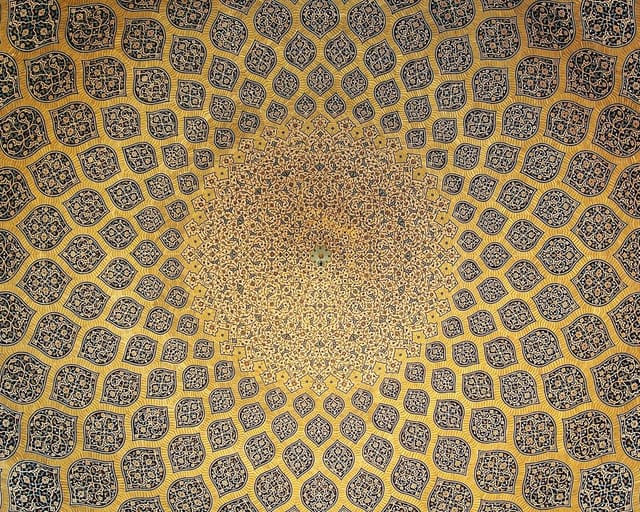
Image: Phillip Maiwald (Nikopol), The inner dome of the Sheikh Lotfollah Mosque, Isfahan, 2008. CC BY-SA 3.0, via Wikimedia Commons.. Image credits
