Is Islam compatible with democracy?
Question 1251
Question
Can a Muslim support democracy, elections, and parliaments, or does Islam require a different system of government?
Summary of answer
Islam is compatible with democracy. The Quran praises believers whose affairs are settled by consultation (shūrā, 42:38) and commanded the Prophet ﷺ himself to consult (3:159). Authority in the Sunnah rests on a pledge freely given, on accountability, and on the rule that there is no obedience in wrongdoing. Elections, a free press, and equal citizenship are modern means for these old commands, and most Muslims in global surveys see no conflict between their faith and democratic values.
Answer
الحمد لله Praise be to Allah.
Some Muslims are told that democracy is a foreign system, that it puts the will of the people in the place of the will of Allah. Others see Muslim countries ruled by kings and generals and wonder whether Islam has anything to say to free government at all. The tradition gives a clear and hopeful answer. Islam is compatible with democracy. The Quran praises a community that settles its affairs by consultation, the Sunnah grounds authority in consent and holds rulers to account, and elections, parliaments, and courts are the modern means of keeping those commands.
What does the Quran say about democracy?
The Quran names a whole chapter after consultation, Sūrat al-Shūrā, and places consultation among the marks of a believing community, between prayer and charity:
وَٱلَّذِينَ ٱسۡتَجَابُواْ لِرَبِّهِمۡ وَأَقَامُواْ ٱلصَّلَوٰةَ وَأَمۡرُهُمۡ شُورَىٰ بَيۡنَهُمۡ وَمِمَّا رَزَقۡنَٰهُمۡ يُنفِقُونَ
“Those who answer their Lord, establish prayer, settle their affairs by consultation among themselves, and give from what We have provided them.”
Allah commanded the Prophet ﷺ himself, who received revelation, to “consult them in the matter” (وَشَاوِرۡهُمۡ فِي ٱلۡأَمۡرِ, Quran 3:159). The verse came down among the passages on the battle of Uhud, after a painful loss, and it still told him to keep consulting. If the Messenger of Allah ﷺ was to govern by consultation, no ruler after him may govern without it.
The Quran also asks every believer to stand for justice against power, including their own:
۞يَـٰٓأَيُّهَا ٱلَّذِينَ ءَامَنُواْ كُونُواْ قَوَّـٰمِينَ بِٱلۡقِسۡطِ شُهَدَآءَ لِلَّهِ وَلَوۡ عَلَىٰٓ أَنفُسِكُمۡ
“You who believe, stand firm for justice as witnesses for Allah, even against yourselves.”
How did the early Muslims choose and question their leaders?
Leadership in early Islam was given by a pledge (bayʿa, بيعة), a contract between ruler and community. The Companions pledged to the Prophet ﷺ to “stand for the truth wherever we are, fearing no one’s blame for Allah’s sake” (Sahih al-Bukhari 7199). Women gave the pledge in their own right (60:12). After ʿUmar’s death, ʿAbd al-Raḥmān ibn ʿAwf spent nights consulting the people of Medina before the pledge to ʿUthmān (Sahih al-Bukhari 7207). The historians preserved Abu Bakr’s first words as caliph: “I have been given authority over you, and I am not the best of you.”
The Prophet ﷺ also set a limit on every ruler’s power:
«لاَ طَاعَةَ فِي مَعْصِيَةٍ، إِنَّمَا الطَّاعَةُ فِي الْمَعْرُوفِ»
“There is no obedience in wrongdoing. Obedience is only in what is right.”
He said that “the ruler is a shepherd and is responsible for his flock” (Sahih al-Bukhari 2409). Consent, consultation, limited authority, and accountability are the heart of what democracy tries to secure. The scholars of every age have known these principles; modern elections, constitutions, and independent courts are new ways to make them work for millions of people at once (Is voting haram?).
Isn’t sovereignty for Allah alone?
The strongest objection comes from the slogan of al-ḥākimiyya, the claim that “judgment belongs to Allah alone” (إِنِ ٱلۡحُكۡمُ إِلَّا لِلَّهِ, 12:40), so that any human lawmaking rebels against Him. Some twentieth-century writers, including Abul Aʿla Mawdudi and Sayyid Qutb, set shūrā against Western democracy in this spirit. Their concern for the sovereignty of Allah is shared by every Muslim.
The slogan is old. The Kharijites raised it against ʿAlī (may Allah be pleased with him) when he accepted arbitration to end a civil war, and ʿAlī answered: “A word of truth by which falsehood is intended” (Sahih Muslim 1066g). Allah’s sovereignty is the reason no ruler may claim to speak for Him without accountability. Human laws on traffic, taxation, schooling, and healthcare are made by people in every system, and the question is whether they are made justly and with the consent of those they bind. The Quran’s justice, the objectives of the sharia, and the rights of every citizen remain the measure (What is sharia?).
Do Muslims support democracy today?
Large surveys by Gallup and Pew across Muslim-majority countries have found that most Muslims see no contradiction between democratic values and their faith. Indonesia, the country with the largest Muslim population in the world, has elected its presidents directly since 2004. Benazir Bhutto became Prime Minister of Pakistan in 1988, the first woman elected to head a democratic government in a Muslim-majority country (Can a woman lead a Muslim country?).
Scholars have built the case in depth. Khaled Abou El Fadl, professor of Islamic law at UCLA, argued in Islam and the Challenge of Democracy (2004) that consultation, accountability, and human dignity make constitutional democracy the form of government best able to serve Islam’s moral commitments. In Iraq after 2003, Grand Ayatollah Ali al-Sistani called for a government chosen by the vote of the people and urged women to vote as a religious duty.
A just democracy also protects faith by leaving it free. There is no compulsion in religion (2:256), and a state that guards the conscience of every citizen guards the sincerity of every believer (What happens to Muslims who leave Islam?).
Consultation as worship
The Quran set consultation between prayer and giving, among the acts of a believing life. Every sincere ballot, every word of counsel to those in power, and every effort to protect the weak is a share in that worship. May Allah make our nations places of justice, and make us among those who “stand firm for justice as witnesses for Allah.”
And Allah knows best. والله أعلم
Frequently asked questions
Is democracy shirk?
No. Shirk is worshipping something besides Allah. Choosing representatives and passing laws by consultation is a worldly arrangement the Quran praises, and citizens who vote worship no one by doing so.
Doesn't sovereignty belong to Allah alone?
All dominion belongs to Allah, and that truth binds rulers first. When the Kharijites used the slogan "judgment belongs to Allah alone" to reject a negotiated peace, ʿAlī called it "a word of truth by which falsehood is intended."
What is the Shia view of democracy?
Shia scholars hold a range of views. Grand Ayatollah Ali al-Sistani in Iraq called for an elected government after 2003, urged Iraqis to vote in 2005, and told women that voting was their religious duty even if their husbands objected.
Can a woman be elected in an Islamic democracy?
Yes. Benazir Bhutto became Prime Minister of Pakistan in 1988, the first woman elected to head a democratic government in a Muslim-majority country, and many have followed.
Related questions
Sources
- Khaled Abou El Fadl, Islam and the Challenge of Democracy (Princeton University Press, 2004)
- Sahih al-Bukhari 2409, 7199, 7207, 7257; Sahih Muslim 1066g
- Ibn Kathir, al-Bidāya wa al-Nihāya (Abu Bakr's first address)
- Islamic democracy (Gallup and Pew findings on Muslim opinion)
- Ali al-Sistani (on elections in Iraq, 2003–2005)
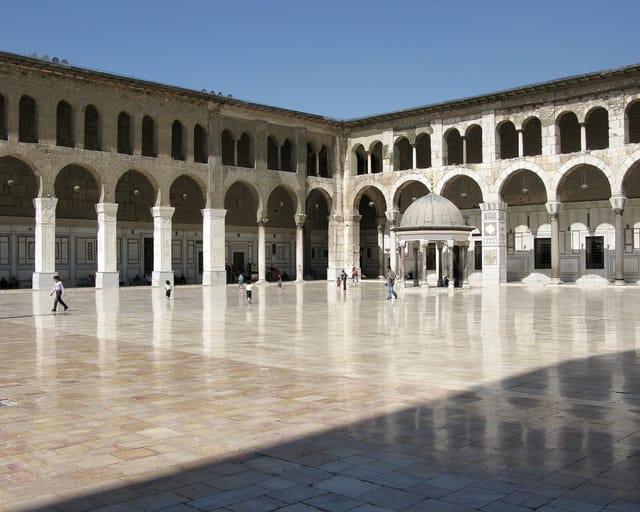
Image: Vyacheslav Argenberg, Courtyard of the Umayyad Mosque, Damascus, 2008. CC BY 4.0, via Wikimedia Commons.. Image credits
