Can Muslims donate or receive blood?
Question 1187
Question
Is it permissible for a Muslim to donate blood, to receive a blood transfusion, and to receive blood from a non-Muslim donor?
Summary of answer
Donating blood is halal and a great act of charity, since whoever saves a life is as though he saved all humanity (5:32). The International Islamic Fiqh Academy permitted donating self-renewing tissue such as blood in 1988, and in 2018 it ruled that giving blood does not break the fast. Receiving blood is permitted, from donors of any faith. Blood should be given freely, since the Prophet ﷺ forbade selling it.
Answer
الحمد لله Praise be to Allah.
Every day hospitals need blood for accident victims, mothers who bleed in childbirth, children with cancer, and patients with sickle cell disease and thalassemia, conditions common in families of African, Middle Eastern, and South Asian heritage. Donating blood is halal, and it is one of the purest forms of charity a Muslim can give. Receiving blood is halal too, from a donor of any faith. The Quran sets the value of a single life beside the value of the whole human race, and the fiqh councils have welcomed blood donation for decades.
Is donating blood halal in Islam?
After the story of the first murder, the Quran states a law for all of humanity:
وَمَنۡ أَحۡيَاهَا فَكَأَنَّمَآ أَحۡيَا ٱلنَّاسَ جَمِيعٗا
“And whoever saves a life, it is as though he had saved all of humanity.”
A pint of blood given during a lunch break can be that saved life. The Prophet ﷺ promised that “whoever relieves a believer of one of the hardships of this world, Allah will relieve him of one of the hardships of the Day of Resurrection” (Sahih Muslim 2699a), and few hardships are greater than a hospital bed waiting for blood.
The International Islamic Fiqh Academy addressed the question in Jeddah in February 1988. In Resolution 26 it defined the organs of the body to include blood, and ruled that “an organ may be transplanted from the body of one person to the body of another person, if such organ is self-regenerating, such as blood and skin,” provided the donor is legally competent. The body replaces donated blood within weeks, so a healthy adult gives without lasting loss. The same reasoning underlies the councils’ wider permission of organ donation (Is organ donation allowed in Islam?).
Isn’t blood impure and forbidden?
The Quran forbids eating “blood poured forth” (Quran 6:145), along with carrion and pork. That ruling concerns food. A transfusion is a medical treatment that enters the veins to keep a patient alive, and even what is forbidden as food becomes permitted in necessity (2:173). Taking blood from the body for health has a clear precedent in the Sunnah: the Prophet ﷺ was treated with cupping (ḥijāma), and he paid the man who cupped him, and Ibn ʿAbbās (may Allah be pleased with him) remarked that he would not have paid him if it were unlawful (Sahih al-Bukhari 2103).
Can Muslims receive blood from non-Muslims?
Yes. Blood has no religion, and Allah says, “We have honored the children of Adam” (17:70). A Muslim may receive blood from any donor, and a Muslim’s donation may save a patient of any faith. The Fiqh Academy also ruled in 2009 (Resolution 184) that when doctors judge treatment such as a blood transfusion to be urgent and necessary, a competent patient has a duty to consent to it. Refusing a needed transfusion out of religious worry has no basis in the sharia, and a family’s fears should never stand between a patient and life-saving care (Does Islam support universal healthcare?).
Does donating blood break the fast or wudu?
The Prophet ﷺ was cupped while he was fasting (Sahih al-Bukhari 1938), and most jurists held that cupping does not break the fast. In 2018, meeting in Medina, the Fiqh Academy ruled in Resolution 219 that blood drawn “for laboratory analysis or for donation” does not break the fast. It also ruled that receiving a transfusion does break it, since blood contains a large quantity of fluid; a patient who needs one is excused and makes up the day later. Many donors still prefer to give after iftar, when they can drink and rest (What breaks your fast?).
On wudu the schools differ. The Hanafi school holds that blood flowing from the body breaks wudu, while the Shafiʿi and Maliki schools hold that it does not. A donor who follows the Hanafi view renews wudu before the next prayer (What breaks wudu?).
Can Muslims sell blood or plasma?
The Prophet ﷺ forbade “the price of blood” (Sahih al-Bukhari 2086), and the Fiqh Academy ruled that no organ may be sold. Most scholars therefore hold that blood and plasma should be given freely. The Academy left open, as a matter for further ijtihād, whether a donor may accept compensation for expenses or “a voluntary compensation as a token of appreciation.” A Muslim who needs blood and can obtain it only by paying commits no sin in paying.
How can Muslim communities help?
- Host blood drives at mosques and Islamic centers, especially in Ramadan evenings and on Eid weekends.
- Encourage young people to register as donors, since some rare blood types are more common in particular ethnic groups and are best matched by donors of the same heritage.
- Give in memory of loved ones. Many Shia communities hold blood drives in Muharram in memory of Imam Ḥusayn, turning grief into life for others.
- Join a stem cell or bone marrow registry as well, which saves patients with leukemia and other blood diseases.
One body
The Prophet ﷺ described the believers as a single living body:
«مَثَلُ الْمُؤْمِنِينَ فِي تَوَادِّهِمْ وَتَرَاحُمِهِمْ وَتَعَاطُفِهِمْ مَثَلُ الْجَسَدِ إِذَا اشْتَكَى مِنْهُ عُضْوٌ تَدَاعَى لَهُ سَائِرُ الْجَسَدِ بِالسَّهَرِ وَالْحُمَّى»
“The believers in their love, mercy, and kindness toward one another are like one body: when one part of it aches, the whole body answers it with sleeplessness and fever.”
When you roll up your sleeve, that body becomes real. May Allah accept every drop you give, and make it a cause of healing for a stranger and of mercy for you on the Day you need it most.
And Allah knows best. والله أعلم
Frequently asked questions
Does donating blood break your fast?
No. The International Islamic Fiqh Academy ruled in 2018 that giving blood for donation or for a test does not break the fast. Many donors still give after iftar, when they can drink and eat to recover.
Does donating blood break wudu?
In the Hanafi school, blood that flows from the body breaks wudu, so a Hanafi donor renews wudu before the next prayer. The Shafiʿi and Maliki schools hold that it does not.
Is donating plasma for money haram?
The Prophet ﷺ forbade the price of blood (Sahih al-Bukhari 2086), so most scholars forbid selling blood or plasma. Reimbursement of travel and time is a matter the Fiqh Academy left open to ijtihād, and giving freely is always the better path.
Can a Muslim receive blood from a non-Muslim?
Yes. Human blood has no religion, and Allah honored all the children of Adam (17:70). No fatwa council restricts transfusions by the faith of the donor.
Related questions
Sources
- International Islamic Fiqh Academy, Resolution 26 (1/4) on Organ Transplantation (Jeddah, 1988)
- International Islamic Fiqh Academy, Resolutions 184 (10/19) on Consent for Emergency Surgeries (Sharjah, 2009) and 219 (3/23) on Invalidators of Fasting in Therapeutics (Medina, 2018), in Resolutions and Recommendations (3rd English ed., 2024)
- Sahih al-Bukhari 1938, 2086, 2103
- Sahih Muslim 2586a, 2699a
- NHS Blood and Transplant, "An Islamic perspective on organ donation"
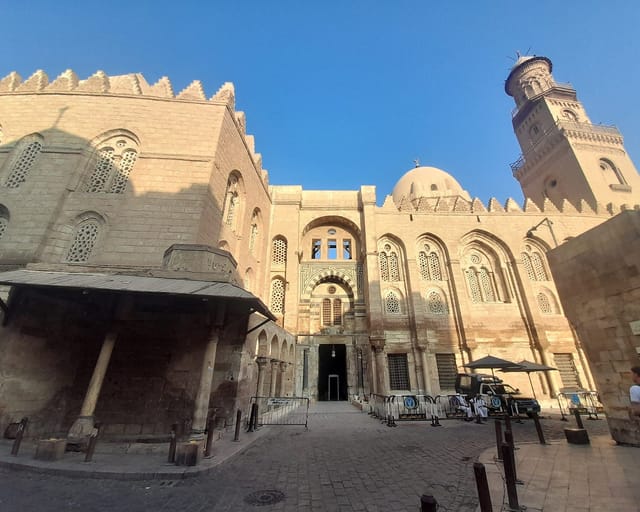
Image: Marsupium, The complex of Sultan Qalawun, Cairo, 2024. CC BY 4.0, via Wikimedia Commons.. Image credits
