How do you pray tahajjud?
Question 1197
Question
How is the tahajjud (night) prayer performed, when is its time, how many rakʿas are prayed, and must you sleep first?
Summary of answer
Tahajjud is the voluntary prayer of the night, prayed between ʿIshāʾ and Fajr, best in the last third of the night when Allah calls out to those who pray. Pray two rakʿas at a time, as many as you can, and close with witr; the Prophet ﷺ usually prayed eleven. Waking from sleep is ideal, and night prayer before sleeping still counts. Two sincere rakʿas kept up regularly are more beloved to Allah than a burst of effort that fades.
Answer
الحمد لله Praise be to Allah.
Tahajjud is the voluntary prayer of the night. You pray it after ʿIshāʾ and before Fajr, ideally after some sleep, two rakʿas at a time, closing with the odd-numbered witr. Its best time is the last third of the night, when the house is still and Allah calls out to anyone who will ask Him. The Prophet ﷺ prayed it throughout his life, and he taught it with gentleness: pray what you can, keep it up, and rest when you are tired.
What is tahajjud?
The word comes from a root meaning sleep, and tahajjud is leaving sleep to pray. The Quran commanded it to the Prophet ﷺ:
وَمِنَ ٱلَّيۡلِ فَتَهَجَّدۡ بِهِۦ نَافِلَةٗ لَّكَ عَسَىٰٓ أَن يَبۡعَثَكَ رَبُّكَ مَقَامٗا مَّحۡمُودٗا
“And keep vigil with it for part of the night, as an extra offering for you. Your Lord may well raise you to a praised station.”
The early verses of Sūrat al-Muzzammil called him to “stand the night, except a little” (Quran 73:2), and said that rising at night leaves the deepest mark and makes speech most upright (73:6). For the community it is a voluntary sunna, and the Prophet ﷺ said, “The best prayer after the obligatory prayers is the prayer of the night” (Sahih Muslim 1163a).
When is the time for tahajjud?
The time begins after the ʿIshāʾ prayer and ends at the start of Fajr. The best part is the last third of the night:
«يَنْزِلُ رَبُّنَا تَبَارَكَ وَتَعَالَى كُلَّ لَيْلَةٍ إِلَى السَّمَاءِ الدُّنْيَا حِينَ يَبْقَى ثُلُثُ اللَّيْلِ الآخِرُ يَقُولُ مَنْ يَدْعُونِي فَأَسْتَجِيبَ لَهُ مَنْ يَسْأَلُنِي فَأُعْطِيَهُ مَنْ يَسْتَغْفِرُنِي فَأَغْفِرَ لَهُ»
“Our Lord, blessed and exalted, descends every night to the lowest heaven when the last third of the night remains, and says: Who will call on Me, that I may answer him? Who will ask of Me, that I may give him? Who will seek My forgiveness, that I may forgive him?”
To find the last third, take the time from Maghrib to Fajr and divide it by three. If Maghrib is at 7:00 pm and Fajr at 5:00 am, the night is ten hours long, and its last third begins at about 1:40 am. Any time after ʿIshāʾ is still night prayer, so choose the hour you can keep.
Do you have to sleep before tahajjud?
Many scholars use the word tahajjud for prayer after rising from sleep, in keeping with its meaning. Every voluntary prayer after ʿIshāʾ is still night prayer (qiyām al-layl, قيام الليل) with its reward. If waking is hard, pray two rakʿas and witr before bed. And if you go to sleep intending to rise and sleep overcomes you, the Prophet ﷺ said that you are rewarded for what you intended, and your sleep is a gift of charity from your Lord (Sunan al-Nasaʾi 1787, graded sahih by al-Albani).
How do you pray tahajjud step by step?
- Intend before sleeping. Set an alarm a little before the time you aim for, and sleep early if you can.
- Wake and freshen up. The Prophet ﷺ cleaned his teeth with the siwāk when he rose at night (Sahih al-Bukhari 245). Make wuḍūʾ (How to make wudu).
- Pray two rakʿas at a time. “The night prayer is two by two,” the Prophet ﷺ said (Sahih al-Bukhari 990). Each pair is prayed like the two rakʿas of Fajr, with the intention of night prayer; the basics are in How do Muslims pray?
- Recite what you know. Long recitation is beautiful, and short recitation is enough (73:20).
- Close with witr. End with one rakʿa, or three, to make the night’s prayer odd: “Make witr the last of your prayer at night” (Sahih al-Bukhari 998).
- Make duʿāʾ. This is the hour of answered prayer. Ask for what you need, in your own words (How do you make dua?).
How many rakʿas is tahajjud?
There is no fixed number. Two rakʿas and witr are enough. Aisha (may Allah be pleased with her) said that the Prophet ﷺ did not pray more than eleven rakʿas at night, in Ramadan or at other times: four, then four, “and do not ask how beautiful and long they were,” then three (Sahih al-Bukhari 1147). Many people pray eight and three witr, following that practice.
What if I feel tired or miss it?
The Prophet ﷺ once saw a rope tied between two pillars of the mosque, put there so that a worshipper could hold on when she grew tired in prayer. He said, “Untie it. Let each of you pray while he has energy, and when he tires, let him sit” (Sahih al-Bukhari 1150). He also said, “The most beloved deeds to Allah are the most constant, even if they are small” (Sahih al-Bukhari 6464).
Aisha said she did not know him to pray a whole night through until morning (Sahih Muslim 746a). When sleep or illness kept him from his night prayer, he prayed twelve rakʿas during the day instead (Sahih Muslim 746e). Allah Himself eased the night prayer for the believers, in the same sura that first commanded it:
عَلِمَ أَن لَّن تُحۡصُوهُ فَتَابَ عَلَيۡكُمۡۖ فَٱقۡرَءُواْ مَا تَيَسَّرَ مِنَ ٱلۡقُرۡءَانِ
“He knew you could not keep count of it all, so He turned to you in mercy. So recite what is easy of the Quran.”
Begin with two rakʿas once or twice a week, and let the habit grow. On special nights, such as the last ten nights of Ramadan, you may wish to pray longer (What is Laylat al-Qadr?).
A closing word
The night prayer is a private meeting. While the world sleeps, you stand before the One who asked, “Who will call on Me, that I may answer him?” Even a few minutes in the dark, with a few verses and a few heartfelt words, can change the day that follows.
And Allah knows best. والله أعلم
Frequently asked questions
Can you pray tahajjud without sleeping first?
Yes. Many scholars reserve the word tahajjud for prayer after waking from sleep, but any voluntary prayer after ʿIshāʾ is night prayer (qiyām al-layl) and carries its reward. If you cannot wake, pray before you sleep.
Can you pray tahajjud after praying witr?
Yes. Pray your night prayer two rakʿas at a time and do not repeat the witr, for the Prophet ﷺ said, "There are no two witrs in one night" (Jamiʿ al-Tirmidhi 470, graded sahih by al-Albani).
Can women pray tahajjud on their period?
A woman who is menstruating leaves the formal prayer for those days. She can still rise in the last third of the night for duʿāʾ, dhikr, and seeking forgiveness, which is the heart of the night's worship.
What should I recite in tahajjud?
Recite al-Fātiḥa and whatever you know of the Quran, long or short. The Quran says of the night prayer, "Recite what is easy of it" (73:20).
Related questions
Sources
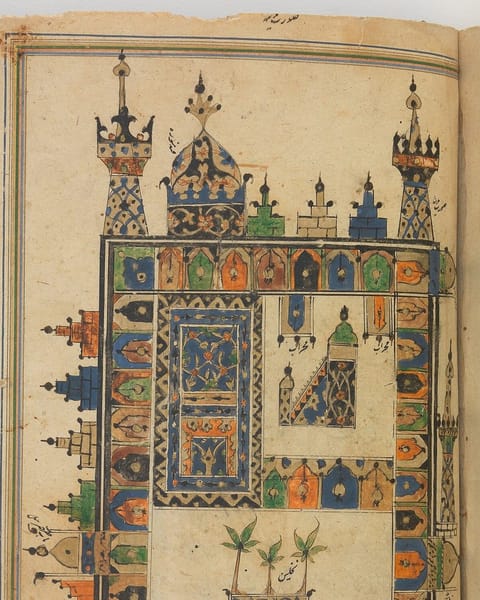
Image: Unknown painter, The Great Mosque of Mecca, from the Futuh al-Haramayn of Muhyi al-Din Lari, 16th century. Metropolitan Museum of Art, New York. CC0, via Wikimedia Commons.. Image credits
_MET_DP231710.jpg)