Is circumcision required in Islam?
Question 1191
Question
Is male circumcision obligatory in Islam, what do the schools of law say, and do adult converts have to be circumcised?
Summary of answer
Male circumcision is one of the practices of the fitra and the way of Abraham, peace be upon him. The schools differ on its strength: the Hanafi and Maliki schools hold it a recommended sunna, while the Shafi'i, Hanbali, and Jaʿfari schools hold it obligatory. A person becomes Muslim by the shahāda alone, and on the stronger view an adult convert is under no obligation to be circumcised.
Answer
الحمد لله Praise be to Allah.
Male circumcision (khitān, ختان) is a sunna of the fitra, the natural way on which Allah created human beings, and a practice that goes back to the prophet Abraham (peace be upon him). Whether circumcision is required in Islam is a question on which the schools of law differ. The Hanafi and Maliki schools hold it a recommended sunna, and the Shafi’i, Hanbali, and Jaʿfari schools hold it obligatory. Every school agrees on the more important point: a person becomes Muslim by bearing witness to the oneness of Allah and the prophethood of Muhammad ﷺ, and circumcision is no condition of faith.
What does the Sunnah say about circumcision?
The Prophet ﷺ placed circumcision at the head of a short list of practices of personal care:
«الْفِطْرَةُ خَمْسٌ ـ أَوْ خَمْسٌ مِنَ الْفِطْرَةِ ـ الْخِتَانُ، وَالاِسْتِحْدَادُ، وَنَتْفُ الإِبْطِ، وَتَقْلِيمُ الأَظْفَارِ، وَقَصُّ الشَّارِبِ»
“Five things belong to the fitra: circumcision, removing the pubic hair, removing the hair of the armpits, trimming the nails, and trimming the mustache.”
The fitra is the original nature Allah gave humanity: “the nature of Allah, upon which He created people” (Quran 30:30). The practices in this hadith are grouped together because they belong to cleanliness and grooming. Most of them, such as trimming the nails, are recommended by agreement, and the scholars who hold circumcision recommended point to this company it keeps.
Why do Muslims circumcise? The way of Abraham
The Prophet ﷺ said that Abraham circumcised himself at the age of eighty (Sahih al-Bukhari 3356). The practice is part of the way (milla) of Abraham, which the Quran commands the Prophet ﷺ to follow:
ثُمَّ أَوۡحَيۡنَآ إِلَيۡكَ أَنِ ٱتَّبِعۡ مِلَّةَ إِبۡرَٰهِيمَ حَنِيفٗا
“Then We revealed to you: follow the way of Abraham, who turned to the truth.”
Circumcision is one of the oldest shared practices of the Abrahamic families. Jews and Muslims both trace it to Abraham, and Muslim families across the world mark it with joy, often with a meal for family and friends.
What do the four schools and the Jaʿfari school say?
- Hanafi and Maliki: circumcision is a sunna, a recommended act. A man who is not circumcised has not committed a sin by leaving it.
- Shafi’i and Hanbali: circumcision is obligatory (wājib) for men. Like every obligation, it falls away for someone who cannot bear it without harm.
- Jaʿfari (Shia): circumcision is obligatory for men.
The Quran does not mention circumcision by name, and the clearest command to circumcise, discussed below, has a weak chain. So the schools reached different conclusions, and each view is a recognized position within the tradition (ikhtilāf). The Hanafi and Maliki view, which treats it as a beautiful sunna and never a test of faith, rests on the plain wording of the fitra hadith.
Do converts have to be circumcised?
A person enters Islam by the shahāda. Nothing else is required to become Muslim, and a man who has just accepted Islam is a full Muslim from that moment, praying, fasting, and belonging to the community. See How do you become Muslim?
On the Hanafi and Maliki view, an adult convert has no obligation to be circumcised. He may choose it as a sunna if he wishes, or leave it. The one report in which the Prophet ﷺ is said to have told a new Muslim to be circumcised has a weak chain: the key words come from an unnamed source (“another man told me”), and hadith scholars such as Shuʿayb al-Arnaʾūṭ graded it weak, though al-Albani graded it hasan (Sunan Abi Dawud 356). Even the schools that hold circumcision obligatory teach that obligations fall away when they cause harm, and the Prophet ﷺ ruled that there is to be “no harm and no returning of harm” (Sunan Ibn Majah 2340, graded sahih by al-Albani). The Quran says of this religion:
وَمَا جَعَلَ عَلَيۡكُمۡ فِي ٱلدِّينِ مِنۡ حَرَجٖ
“And He has placed no hardship on you in religion.”
A new Muslim should never be pressured about circumcision, asked about it, or made to feel that his Islam is incomplete. Like changing one’s name, it is a personal decision (see Do converts to Islam have to change their name?). The first months of Islam are for learning to pray, meeting the community, and tasting the sweetness of faith, as described in How can a new Muslim fast Ramadan?
At what age should a boy be circumcised?
Islam sets no fixed age. Many families circumcise in infancy, others in early childhood, and in some regions boys are circumcised around the age of ten or after completing their first reading of the Quran. Whatever the age, the procedure should be done by a qualified medical professional, with proper pain relief and hygiene, because protecting the child from harm is part of the same Sunnah.
Female circumcision is a different matter entirely. It has no basis in the Quran or sound hadith, it causes lasting harm, and the leading scholars of our time forbid it, as explained in Is female circumcision required in Islam?
A closing word
The practices of the fitra are small acts of care for the body Allah entrusted to us, and their spirit is cleanliness, gentleness, and gratitude. Whether a family circumcises its sons as a sunna or as a duty, and whether a convert chooses it or leaves it, the heart of the matter lies elsewhere. The Prophet ﷺ said, “Allah does not look at your forms or your wealth. He looks at your hearts and your deeds” (Sahih Muslim 2564c).
And Allah knows best. والله أعلم
Frequently asked questions
Is circumcision mentioned in the Quran?
The Quran does not mention circumcision by name. The practice comes from the Sunnah, which counts it among the five practices of the fitra, and from the way of Abraham, which the Quran tells the Prophet ﷺ to follow (16:123).
Is the prayer of an uncircumcised man valid?
Yes. His prayer is valid as long as he has the ritual purity required for prayer, which means keeping the area clean after using the toilet. Circumcision is no condition of prayer, fasting, or any other act of worship.
What is the Shia view on circumcision?
The Jaʿfari (Shia) school holds male circumcision obligatory, as do the Shafi'i and Hanbali schools among the Sunnis. The Hanafi and Maliki schools hold it a recommended sunna.
Is female circumcision the same?
No. Female circumcision has no basis in the Quran or sound hadith and causes serious harm; leading scholars, including Egypt's Grand Mufti, forbid it. See the separate answer on female circumcision.
Related questions
Sources
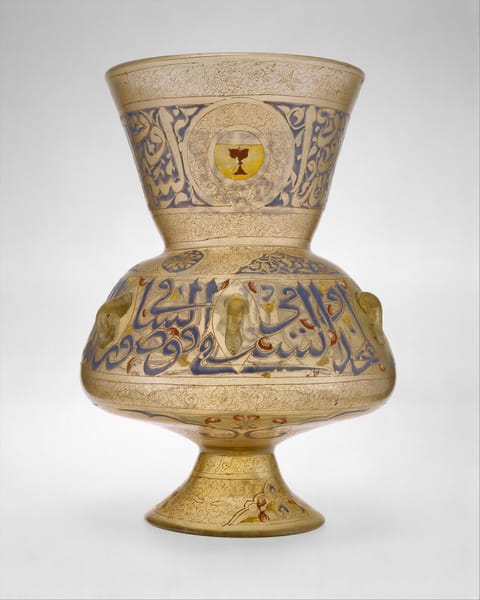
Image: ʿAli ibn Muhammad al-Barmaki, Mosque lamp of Amir Qawsun, Cairo, c. 1329–1335. Metropolitan Museum of Art, New York. CC0, via Wikimedia Commons.. Image credits
